

When you request a quote for vehicle reconditioning, the final number often causes surprise. A standard drive-through car wash costs around $15, while professional auto detailing ranges from $150 to upwards of $600.
The vast price difference stems from the depth of the service provided. A simple wash removes loose surface dust, whereas detailing restores the vehicle to a near-factory state.
Understanding what actually goes into car detailing pricing (time, labor, and chemicals breakdown) helps vehicle owners evaluate these costs fairly.
The expense is a direct reflection of meticulous physical work, professional-grade shop supplies, and the hours required to transform a vehicle safely.
What Actually Goes Into Car Detailing Pricing?
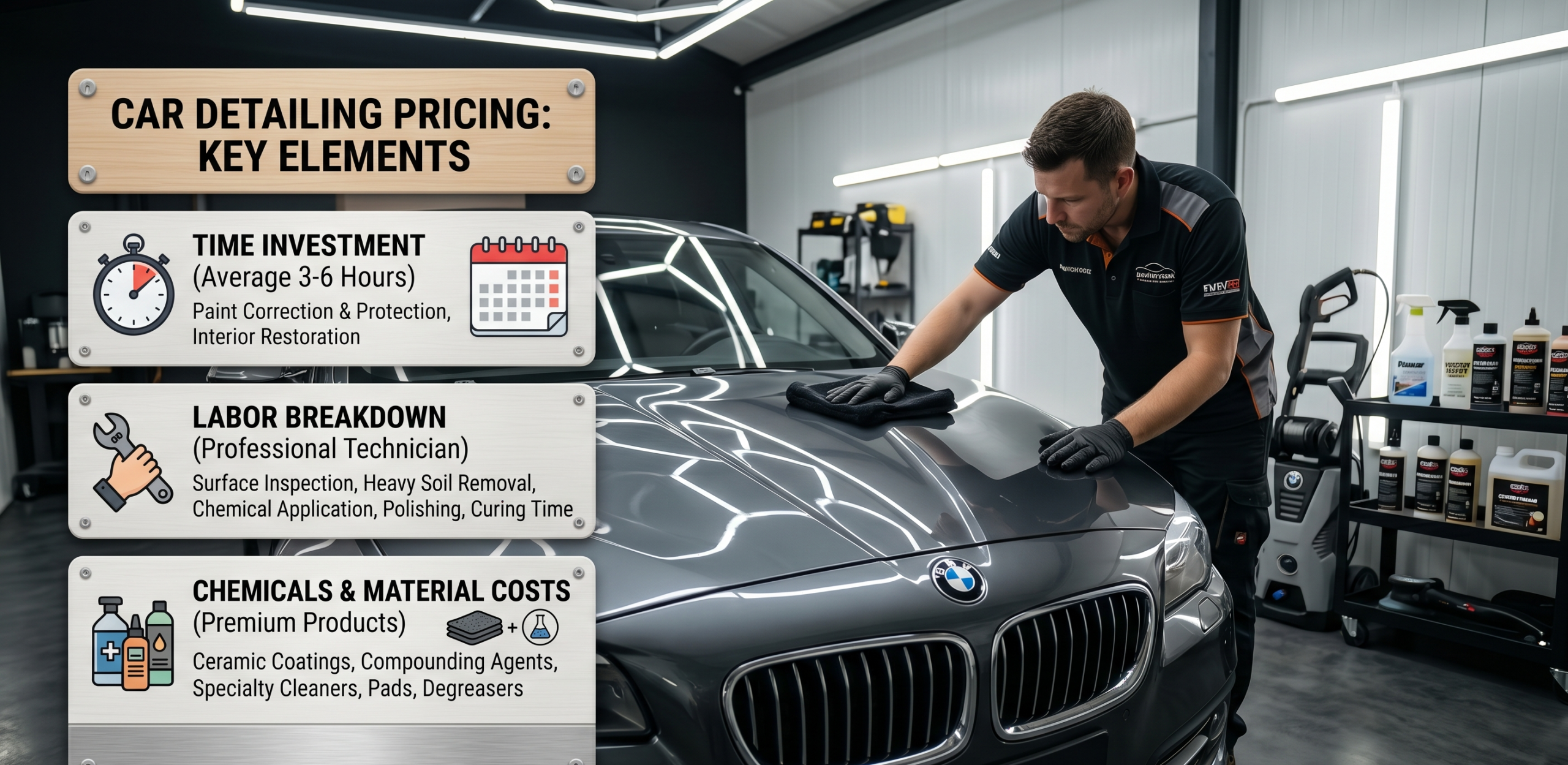
The total cost of a detailing service relies on three primary pillars: time investment, labor intensity, and chemical resource costs.
A professional shop calculates rates by determining how many hours a project requires. They factor in the physical toll of the labor and the precise volume of specialty products consumed during the deep cleaning process.
The Core Pricing Formula
Most professional operations use a baseline formula to establish their retail rates:
{Total Price} = {Hourly Labor Rate} \{Estimated Hours}) + Chemical/Supply Cost} + {Fixed Overhead Allocation}
Every vehicle presents unique challenges that alter this baseline equation. A compact sedan with light dust requires far fewer resources than a large SUV covered in pet hair or muddy residue.
The Time Factor: Why True Detailing Takes Hours?
Time is the most rigid variable in auto reconditioning. Unlike automated machinery, human hands cannot speed past the physical constraints of paint correction or deep carpet extraction without sacrificing safety and results.
Average Time Breakdown by Vehicle Category
The physical footprint of a vehicle dictates the minimum baseline hours required for a standard package.
- Coupes and Compact Sedans: 3 to 5 Hours
- Full-Size Sedans and Crossovers: 4 to 6 Hours
- Three-Row SUVs and Large Trucks: 6 to 8 Hours
- Commercial Vans and Lifted Trucks: 8+ Hours
Why Complex Detailing Tasks Extend the Clock?
Certain restoration jobs demand extreme patience. For instance, paint correction involves using machine polishers to safely level the clear coat, removing microscopic swirls and scratches.
| Detailing Task | Average Time Investment |
|---|---|
| Standard Multi-Stage Exterior Wash & Decontamination | 1.5 to 2 Hours |
| Full Interior Vacuum, Steam, & Leather Conditioning | 2 to 4 Hours |
| Single-Stage Paint Correction (Swirl Removal) | 4 to 6 Hours |
| Multi-Stage Paint Correction (Deep Scratch Repair) | 8 to 16 Hours |
| Ceramic Coating Application & Curing Setup | 2 to 4 Hours |
When a vehicle requires multi-stage paint correction, a technician might spend two whole working days on a single vehicle. The clock directly dictates the price.
The Labor Factor: Skilled Expertise and Physical Demands
Labor costs constitute the largest percentage of professional detailing fees. The job requires highly physical, exhausting work that demands precise technical skills.
Physical Demands of the Trade
Detailing forces technicians to work in cramped, uncomfortable environments for hours at a time. They kneel on hard floors to scrub seat tracks, lean over hot hoods to balance heavy machine polishers, and squeeze into tight trunks.
The physical exertion creates structural overhead for a business. Shops must pay competitive wages to retain experienced technicians who can work safely without burning out.
Technical Skill and Liability Risk
True professional detailing is skilled labor, not entry-level manual work. Technicians handle fragile, expensive materials that are easily ruined by improper techniques.
- Paint Gauge Management: Modern factory paint is incredibly thin. Technicians use digital paint depth gauges to measure microscopic clear coat thickness before polishing. This prevents burning through the clear coat, which triggers an expensive repainting bill.
- Delicate Interior Surfaces: Modern cabins feature sensitive electronics, fragile digital displays, and open-pore wood trims. Using the wrong tool or applying excessive moisture can destroy electronic modules or permanently stain rare leathers.
- Rotary Buffer Control: Managing a high-speed rotary polisher requires muscle memory and steady pressure. A split-second mistake can catch an edge, strip the paint off a bumper panel, or leave deep holograms in the finish.
Customers pay for the peace of mind that comes with hiring an insured, highly trained technician who knows how to avoid damage.
The Chemical Breakdown: Professional Grade vs. Retail Consumer Products
The fluids, sprays, soaps, and protectants used in a professional shop bear little resemblance to generic retail car wash soaps. True professional formulations are specialized industrial compounds designed for maximum safety, speed, and durability.
Cost Differences in Product Categories
Professional detailers purchase concentrated solutions that require precise dilution ratios based on the specific cleaning task at hand.
- pH-Neutral Foam Shampoos: These soaps lift road film safely without stripping pre-existing waxes or delicate rubber seals.
- Iron Removers: These specialized sprays turn purple when interacting with embedded sintered iron brake dust particles, safely dissolving them chemically so they can be rinsed away without scratching the paint.
- Alkaline vs. Acidic Cleaners: Technicians switch between non-acidic wheel cleaners for delicate aluminum rims and heavy-duty, target-specific degreasers for oily engine bays.
High-End Surface Coatings
The protective products applied at the end of a detail significantly affect the overall pricing.
- Traditional Carnauba Waxes: Affordable material costs, but they only protect for 4 to 6 weeks.
- Synthetic Polymer Sealants: Moderate cost, offering reliable protection for 3 to 6 months.
- Professional Ceramic Coatings: Highly expensive, specialized liquid nanoceramic formulas. A small 50ml bottle can cost up to $150. These coatings require precise surface preparation, clean room environments, and expert installation to deliver 2 to 5 years of durable, hydrophobic paint protection.
Hidden Factors That Directly Influence Detailing Estimates
Beyond basic time, labor, and chemical metrics, specific vehicle conditions can quickly increase a standard estimate.
Excessive Interior Debris and Pet Hair
Pet hair features tiny microscopic barbs that lock securely into the weave of automotive carpets. Standard vacuuming will not dislodge it.
Technicians must use specialized rubber pumice stones, static brushes, and dedicated fur extractors to pull the hair free slowly. If a car’s interior is covered in pet hair, expect shops to add an extra fee to account for the additional hour or two of intense manual labor.
Biohazard Remediation Procedures
Dealing with spilled milk, mold growth, or bodily fluids requires strict safety protocols. Technicians must don protective gear and use specialized commercial equipment to sanitize the vehicle completely.
- Commercial Steam Extractors: These machines inject pressurized water heated past 200 degrees Fahrenheit deep into fabric cushions, instantly killing bacteria and extracting old residue.
- Industrial Ozone Generators: Shops run ozone machines inside sealed cabins to destroy stubborn, embedded odor molecules at a molecular level.
Mobile Detailing vs. Fixed Location Shops
Mobile detailing operations bring the entire shop directly to your driveway. This saves you a trip, but it introduces distinct operational costs that alter pricing structures.
Mobile operators must maintain specialized vans equipped with commercial water tanks, quiet power generators, and heavy-duty pressure washers. Their final quotes factor in travel time, vehicle fuel, and vehicle maintenance costs.
How Vehicle Owners Can Evaluate a Detailing Quote?
When comparing quotes from different shops, look closely at exactly what is included in the service scope.
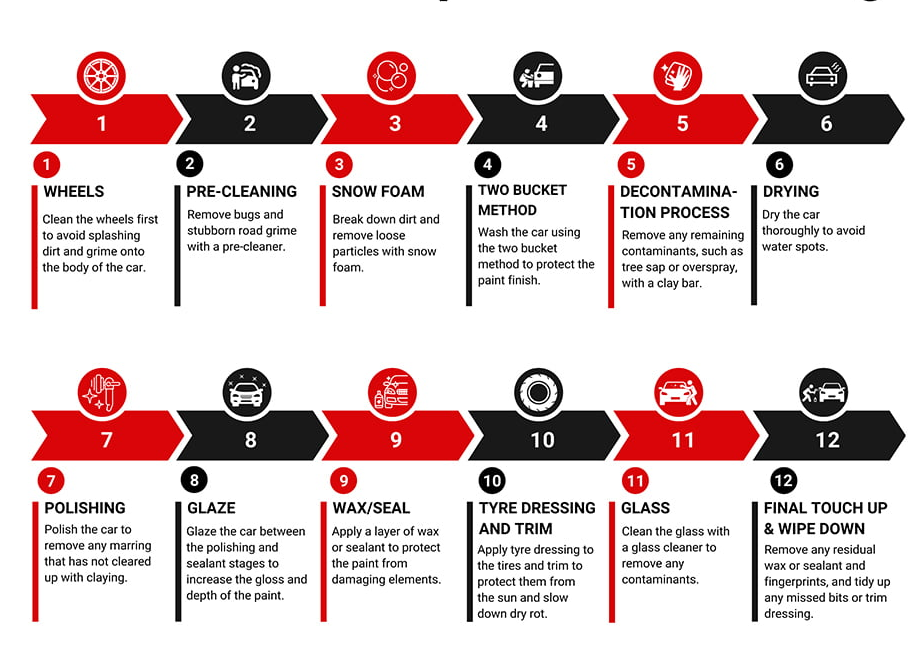
- Ask for a Clear Checklist: A quality business will provide an itemized breakdown showing exactly what steps they will perform on your vehicle.
- Verify Licensing and Insurance: Ensure the shop carries comprehensive garagekeeper’s insurance to protect your vehicle while it is in their care.
- Prioritize Long-Term Protection: A higher upfront price that includes paint decontamination and a high-quality sealant saves you money over time by preserving your car’s resale value.
Ultimately, evaluating what actually goes into car detailing pricing (time, labor, chemicals breakdown) reveals that you are investing in skilled, asset-preserving maintenance.
The multi-step process safely deep-cleans every surface, protecting your vehicle’s long-term value far better than any quick surface wash ever could.
