

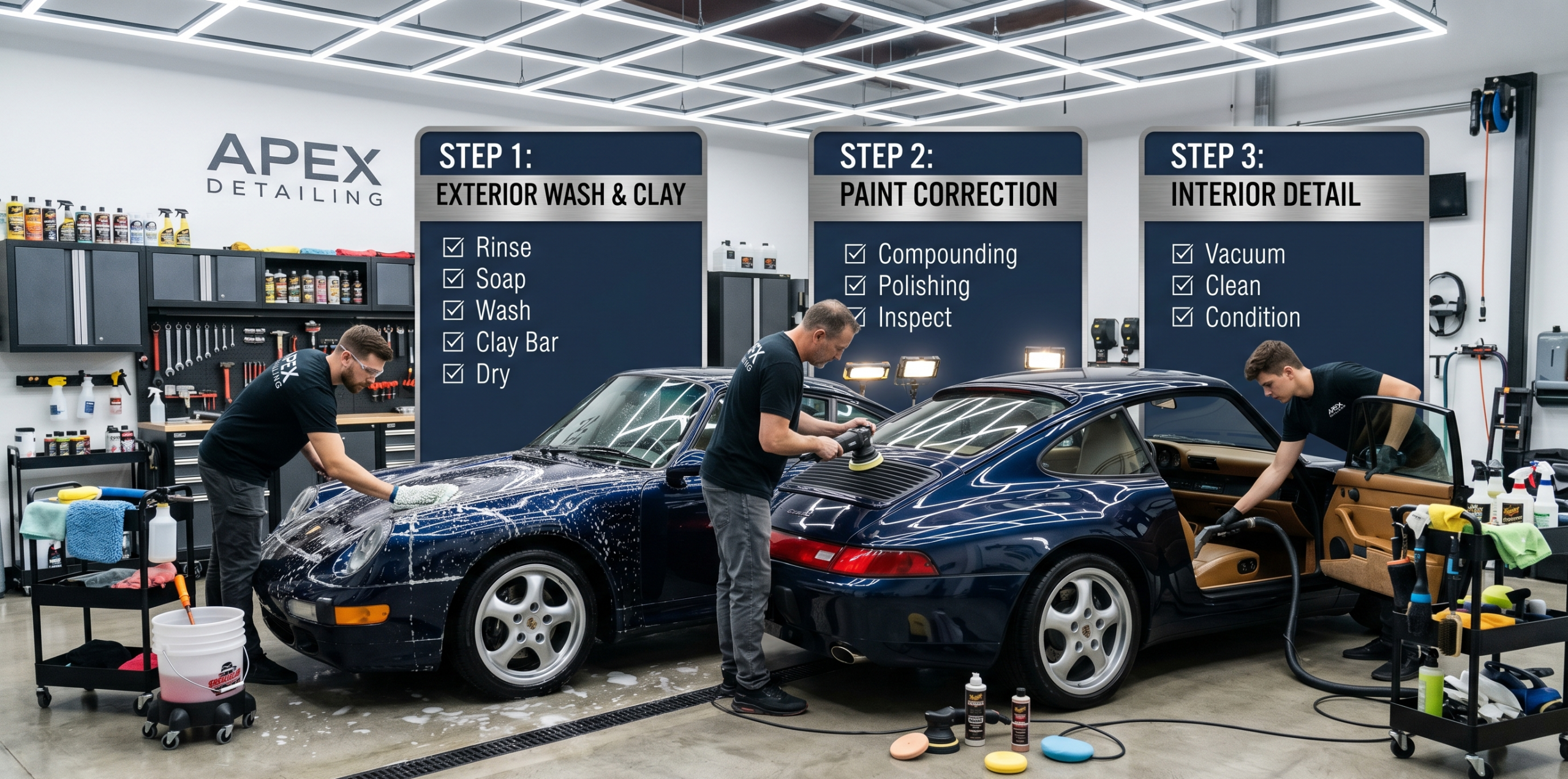
Car detailing is the thorough cleaning, restoration, and finishing of a vehicle to produce show-quality cleanliness and polish. Unlike a quick automated car wash, detailing requires precise manual techniques to protect your vehicle’s paint and interior surfaces.
Many car owners wonder: What is the best way to detail a car at home? The definitive answer lies in executing a systematic, two-stage process. First, perform a careful multi-bucket exterior wash to eliminate paint-scratching contaminants. Second, clean and condition every interior material using surface-specific formulas.
1. Essential Car Detailing Tools and Supplies
Before touching your vehicle’s paint, you must gather the correct chemical formulas and physical tools. Using the wrong equipment can inflict permanent scratches and swirl marks on your clear coat.
Wash and Prep Equipment
- Three Five-Gallon Buckets: Dedicated separately to soapy wash water, clean rinse water, and wheel cleaning.
- Grit Guards: Plastic inserts placed at the bottom of your buckets to trap heavy dirt particles and prevent them from returning to your wash mitt.
- Microfiber Wash Mitts: High-pile microfiber traps dirt within its fibers rather than dragging it across the paint surface.
- Dedicated Wheel Brushes: Soft-bristle brushes for barrel cleaning and stiff brushes for tire sidewalls.
Specialized Cleaning Chemicals
- pH-Neutral Car Wash Shampoo: Specialized automotive soaps lubricate the surface without stripping existing waxes or sealants.
- Dedicated Wheel and Tire Cleaner: Non-acidic formulas break down baked-on metallic brake dust and heavy road grime safely.
- Clay Bar or Synthetic Clay Mitt: An engineered resin compound that shears bonded environmental contaminants off the smooth paint finish.
- Isopropanol (IPA) Prep Spray: A diluted alcohol solution used to strip remaining oils and old waxes prior to applying new protection.
Interior and Finishes
- Dedicated Interior Cleaner: Mild, non-greasy surfactant cleaners designed for plastics, vinyl, and dashboard components.
- Dual-Action (DA) Orbital Polisher: A machine that safely removes paint defects without the risk of burning through the clear coat.
- Premium Paint Protection: High-grade carnauba wax, synthetic polymer sealants, or quartz-based ceramic coatings.
2. Advanced Exterior Washing Techniques
The foundation of the ultimate car detailing guide relies on safe washing procedures. Most paint imperfections are caused by improper washing techniques that drag abrasive dirt across the clear coat.
The Essential Wheel Cleaning Protocol
Always clean your wheels and tires before touching the painted body panels. This order prevents highly abrasive brake dust and dirty water from splashing onto already cleaned paint surfaces.
Apply your specialized wheel cleaner directly to a cool rim and let it dwell for two minutes to dissolve metallic particles. Use your long-reach barrel brush to clean the inner rim area, then switch to a soft microfiber brush for the face of the wheel.
Scrub the tire sidewalls with a stiff brush to remove blooming, which is the brown oxidation that occurs on old rubber. Rinse the entire wheel assembly thoroughly with a sharp stream of water before moving to the next corner.
The Three-Bucket Wash Method Explained
To eliminate wash-induced scratches, set up three separate buckets equipped with grit guards to isolate trapped debris.
- Bucket 1: Wheel Wash: Used exclusively for dirty rims, tires, and wheel wells.
- Bucket 2: Clean Rinse: Filled with pure water to clean the wash mitt after each panel.
- Bucket 3: Soap Wash: Filled with water and premium pH-neutral car shampoo.
Begin by rinsing the vehicle from top to bottom to remove loose dirt. Submerge your microfiber wash mitt into the soapy bucket, then wash one single vehicle panel using straight, linear motions.
Never move the mitt in circles, as circular patterns create visible web-like swirl marks under direct sunlight. After completing a panel, plunge the dirty mitt into the clean rinse bucket and agitate it against the grit guard to release trapped particles.
Wring the mitt out completely before dipping it back into the soap bucket for the next panel.
Decontamination and Clay Bar Treatment
Even after a thorough wash, industrial fallout, rail dust, and tree sap remain chemically bonded to your clear coat. Run your clean hand across the dry paint; if it feels rough like sandpaper, the surface requires deep decontamination.
Spray a dedicated clay lubricant generously over a two-foot by two-foot paint section. Glide the detailing clay bar gently across the lubricated area using light finger pressure in straight lines.
The clay will grab initially, then slide smoothly once it removes the embedded contaminants. Periodically knead the clay bar to expose a fresh, clean surface to ensure you are not rubbing trapped grit back into the paint finish.
3. Paint Correction and Imperfection Removal
Paint correction is the mechanical process of leveling the clear coat to eliminate swirl marks, fine scratches, and oxidation. This step restores optical clarity, allowing light to reflect perfectly off the surface.
Assessing the Condition of Your Clear Coat
Wipe the vehicle down with a diluted isopropanol solution to remove any filler oils or gloss enhancers left by car shampoos. Position a high-intensity detailing light directly against the panel to reveal the true depth of the paint imperfections.
- Clear Coat: (Swirl Marks / Fine Scratches).
- Base Coat: (Color Layer).
- Primer: (Bonding Layer).
If scratches disappear when the vehicle is wet but reappear when dry, they reside solely within the upper clear coat layer.
These superficial defects can be safely polished out. Scratches that expose grey primer or bare metal require professional paint touch-up work.
The Compound and Polish Selection Matrix
Choosing the right machine pad and liquid chemical configuration prevents excessive clear coat removal while achieving excellent clarity.
| Defect Severity | Pad Type | Chemical Agent | Expected Outcome |
| Heavy Oxidation / Deep Scratches | Microfiber or Heavy Foam | Cutting Compound | Removes heavy defects; leaves minor haze |
| Moderate Swirls / Light Marring | Medium Polishing Foam | Finishing Polish | Restores gloss; refines compound haze |
| Minor Haze / Daily Micro-Marring | Ultra-Soft Finishing Foam | Ultra-Fine Jeweling Polish | Maximum depth, clarity, and reflection |
Apply four pea-sized drops of compound onto your chosen foam pad. Set your dual-action polisher to a low speed setting and spread the product evenly across a small work area. Increase the machine speed to a moderate level and apply light, downward pressure.
Move the machine slowly in overlapping horizontal and vertical passes, completing four to five cycles per section. Wipe away the residue immediately with a clean, plush microfiber towel.
4. Applying Long-Lasting Paint Protection
Unprotected clear coats degrade quickly when exposed to solar ultraviolet radiation, acid rain, and bird droppings. Applying a durable layer of protection seals the corrected paint and creates a hydrophobic barrier.
Traditional Wax vs. Synthetic Sealants vs. Ceramic Coatings
Carnauba wax offers a deep, warm gloss but breaks down within six to eight weeks under warm weather conditions. Synthetic polymer sealants provide a highly reflective shine and bond tightly to the paint, offering protection that lasts four to six months.
True quartz-based ceramic coatings utilize silicon dioxide to form a permanent, glass-like layer over the vehicle.
This advanced barrier resists minor scratches, repels dirt effortlessly, and lasts between two and five years, depending on product composition.
Step-by-Step Protection Application
Ensure the vehicle is parked in a shaded, climate-controlled environment away from direct sunlight and wind-blown dust.
Using an ultra-soft foam applicator pad, apply your chosen wax or sealant in a thin, uniform layer across the entire vehicle. Allow the product to cure according to the manufacturer’s specific instructions, which typically takes fifteen to thirty minutes.
Test the readiness by wiping a clean finger across the haze; if it streaks, it needs more time, but if it clears cleanly, it is ready.
Buff the cured haze to a mirror finish using a clean, high-gsm microfiber towel, flipping the cloth frequently to avoid buildup.
5. Comprehensive Interior Detailing Guide
A pristine interior is critical for driver comfort and preserving the interior component materials from dry-rotting or fading over time.
Complete Cabin Vacuuming Technique
Remove all floor mats, personal items, and trash from the cabin before starting your vacuum cleaner. Slide the front seats completely forward to expose the hidden debris accumulating in the rear footwells.
Use a stiff-bristled nylon brush to agitate the carpet fibers, lifting trapped sand and pet hair to the surface.
Vacuum the entire floor using a high-suction utility vacuum fitted with a narrow crevice tool for seat tracks and map pockets.
Use a soft, round horsehair brush attachment on delicate dashboard screens, air vents, and console buttons to prevent scratching soft plastics.
Cleaning Leather, Vinyl, and Plastic Trim
Different interior surfaces require specific chemical care to clean without damaging delicate dyes or factory matte finishes.
- Dashboard & Plastics: Mild surfactant cleaner + microfiber towel -> Matte UV protectant.
- Leather Seating: pH-balanced leather cleaner + soft brush -> Conditioning cream.
- Fabric Upholstery: Low-moisture enzyme cleaner + extraction -> Fabric sealant.
Spray a mild interior cleaner onto a clean microfiber towel rather than directly onto the dashboard to prevent overspray behind instrument clusters.
Wipe down the plastic, vinyl, and trim pieces to remove skin oils and dust. For leather seats, work a pH-balanced leather cleaner into the pores using a soft horsehair brush to loosen embedded body grime.
Wipe the surface completely dry with a clean cloth, then apply a premium conditioning cream to keep the leather supple.
6. Perfecting the Details: Glass, Trim, and Tires
The difference between an amateur cleaning job and a professional-grade detail lies in the final finishing touches on glass and exterior trim.
Achieving Streak-Free Automotive Glass
Automotive glass accumulates a stubborn, greasy film caused by interior plastic outgassing and environmental road oils. Clean your windows last to remove any stray overspray from your interior or exterior detailing chemicals.
Spray an alcohol-based, ammonia-free glass cleaner lightly over the window surface. Wipe the glass using a tight-weave waffle-knit microfiber towel to scrub away the film.
Switch immediately to a second, completely dry microfiber towel to perform the final buffing pass.
When cleaning the interior glass, wipe the driver’s side horizontally and the passenger’s side vertically. If any streaks appear, this directional pattern tells you instantly which side of the glass requires a corrective wipe.
Restoring Exterior Plastics and Tires
Unprotected exterior plastic trim degrades under UV light, turning a chalky grey color over time. Apply a dedicated exterior trim restorer containing UV inhibitors to deep-clean and darken the porous plastic panels.
Finish the process by applying a water-based tire dressing to the clean tire sidewalls using a curved foam applicator.
Water-based dressings provide a clean satin appearance and will not sling sticky black residue onto your clean side panels when driving.
Final Maintenance Recommendations
To preserve this high-level finish, avoid automated mechanical car washes that use abrasive plastic brushes. Wash your vehicle every two weeks using the safe three-bucket method described in this guide. Reapply a sacrificial spray sealant every three months to boost the hydrophobic properties of your primary paint protection layer.
For authoritative safety guidelines on handling chemical products used during detailing, review the official OSHA Automotive Maintenance Standards.
For detailed technical insights into paint thickness measurements and clear coat properties, consult the Society of Automotive Engineers.
