

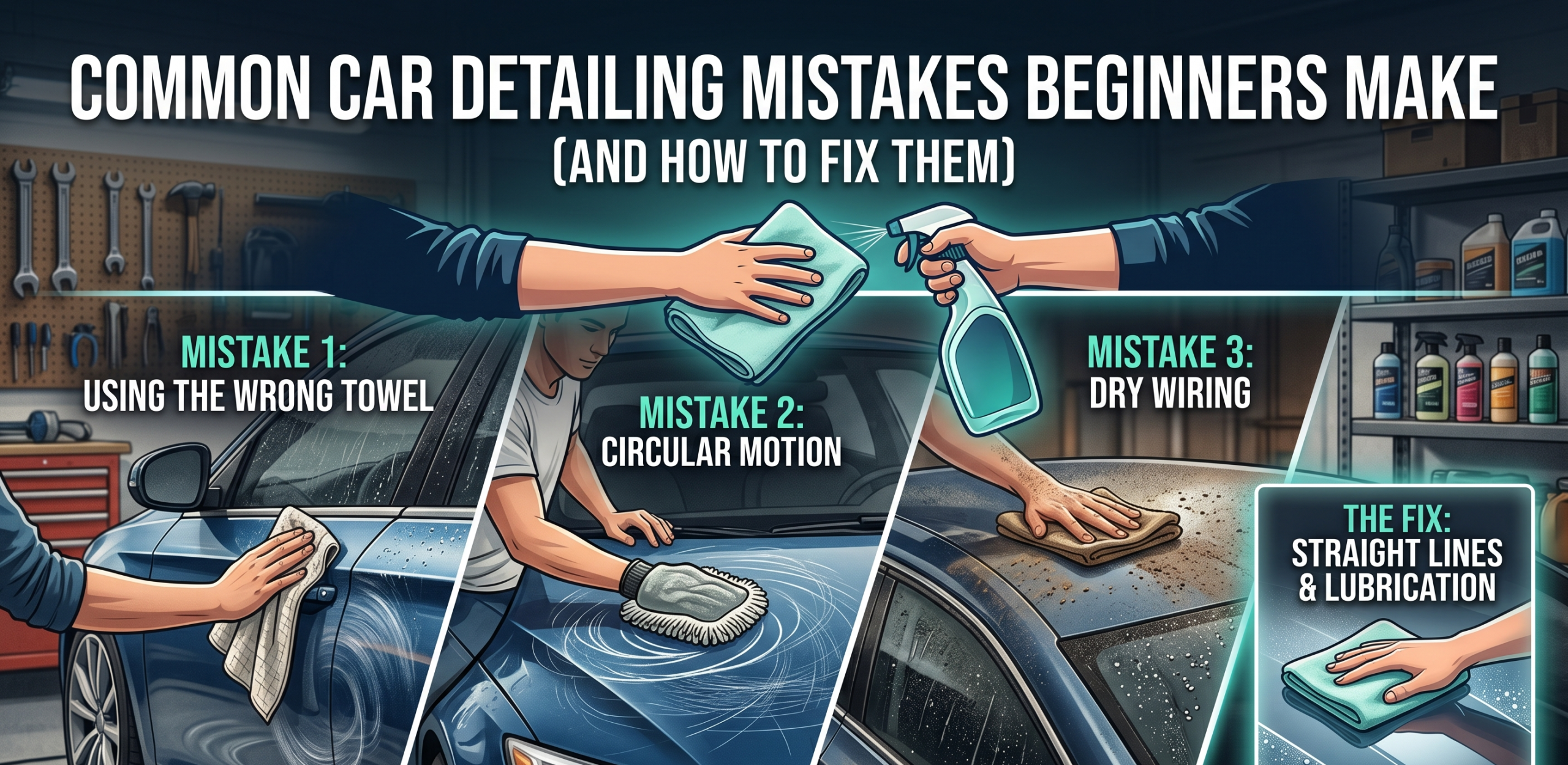
Starting car detailing without the right knowledge leads to scratched paint, water spots, and wasted money on products that do more harm than good.
Most beginners damage their car’s finish before they even realize what went wrong.
Using the Wrong Wash Mitt or Sponge
The biggest source of swirl marks and fine scratches is the washing tool itself. Regular household sponges trap dirt particles against the paint surface and drag them across the clear coat.
That friction creates micro-scratches that show up clearly under sunlight.
Use a microfiber wash mitt with deep pile fibers. The dirt lifts into the fibers instead of sitting on the surface against your paint.
Rinse the mitt frequently during the wash so you’re not reapplying contamination back onto the car.
Washing in Direct Sunlight
Washing your car under the sun seems harmless. It’s not. The heat causes soap and water to dry faster than you can rinse them off, leaving mineral deposits and water spots baked into the paint.
Always wash in a shaded area or during early morning and late evening. If the surface feels hot to the touch, let it cool before you start. This single change prevents the majority of water spot issues beginners deal with.
According to Meguiar’s detailing guidelines, paint temperature directly affects how products bond and perform.
Using One Bucket Instead of Two
Most beginners use one bucket for everything. Rinse the mitt in the same soapy water you’re using to wash, and you’re dragging grit right back onto the paint with each pass.
The two-bucket method is standard practice for a reason. One bucket holds clean, soapy water. The second bucket holds plain water for rinsing the mitt before reloading it with soap.
Add a grit guard to the bottom of each bucket to trap sediment below the water line. It takes an extra 30 seconds to set up and eliminates a major source of scratches.
Skipping the Pre-Rinse
Jumping straight to washing without rinsing the car first drags loose dirt, dust, and debris across the paint with your mitt. That abrasion is entirely avoidable.
A thorough pre-rinse with a hose or pressure washer removes the surface-level contamination before you touch the paint. Rinse from the top down. Let the water carry dirt off the panels rather than scrubbing it into them.
Using Dish Soap to Wash the Car
Dish soap strips grease, which would work well on a car. The problem is that it also strips wax, sealants, and protective coatings.
Repeated use degrades the paint’s protection layer and eventually leaves the clear coat vulnerable to oxidation and UV damage.
Use a dedicated car wash shampoo. Products like Chemical Guys Honeydew Snow Foam or similar pH-neutral shampoos clean effectively without breaking down existing protection. They’re formulated specifically for automotive finishes.
Drying with a Regular Towel or Chamois
Terry cloth towels and synthetic chamois look like they work. In practice, they leave fine scratches, don’t absorb water efficiently, and often trap particles against the paint during drying.
A plush microfiber drying towel pulls water off the surface with minimal contact. The correct technique is to lay the towel flat on the panel and pull it across the surface rather than scrubbing back and forth.
A forced-air blower removes water from mirrors, door jambs, and trim gaps where towels can’t reach cleanly.
Applying Wax to a Dirty or Uncorrected Surface
Wax does not fix surface contamination or paint defects. It seals whatever is underneath it. If you apply wax over iron deposits, industrial fallout, or light scratches, you lock those problems in place and make them harder to address later.
Before waxing, the paint needs to be:
- Washed and dried thoroughly.
- Clayed to remove bonded contamination.
- Polished if there are swirl marks or scratches.
Only after those steps does wax or sealant make sense. The International Detailing Association outlines this process as the foundation of proper paint care.
Skipping Clay Bar Treatment
Clay bar is one of the most overlooked steps in beginner detailing. Even a freshly washed car holds bonded contamination that soap can’t remove: industrial fallout, tree sap residue, rail dust, and overspray.
You can feel this as roughness when you run a clean finger across a dry panel.
Clay bar treatment removes that contamination by pulling it out of the paint. Use it with a clay lubricant spray — never dry.
Work in small sections and fold the clay frequently to expose a clean surface. After claying, the paint should feel smooth like glass.
Over-Applying Product
More product does not mean better results. Wax, polish, and ceramic coatings work in thin, even layers. Thick application creates smearing, uneven cure, and difficult removal that can leave hazing on the paint.
A pea-sized amount of polish or wax covers a 2×2-foot section comfortably. Work in small areas, spread thin, and buff off before moving to the next panel.
This approach saves product, reduces application time, and gives better results than heavy coats.
Using the Same Towel for Everything
One microfiber towel for wax removal, interior wipe down, glass cleaning, and drying — a common habit that causes problems.
Towels pick up silicone, oils, and cleaning agents from different surfaces. Using a wax removal towel on glass leaves streaks. Using a dirty towel on a freshly polished panel introduces contamination.
Dedicate specific towels for specific tasks. Color-code them if needed. Keep glass towels completely separate from paint towels.
Wash them separately and avoid fabric softener, which clogs microfiber and reduces absorbency.
Ignoring Interior Contamination During Exterior Detailing
Beginners often focus entirely on the exterior while the interior accumulates dust and debris. That debris eventually ends up on exterior surfaces through open doors and windows.
Worse, interior cleaning done carelessly, spraying products near open windows, walking around with dirty shoes, drags contamination back to a freshly cleaned exterior.
Work on interior and exterior detailing as a complete process. Vacuum and wipe the interior first. Use an air compressor or detailing brush to clear dust from vents, seams, and dash crevices before wiping.
This prevents dust redistribution after the final wipe.
Not Protecting Trim and Rubber During Polishing
Running a polisher across painted panels without masking adjacent trim and rubber strips leaves white residue in textured areas that’s difficult to remove. Polish and compound bond into porous surfaces and turn chalky as they dry.
Use painter’s tape to mask trim lines before polishing. On areas where tape isn’t practical, apply a thin layer of petroleum jelly to the trim beforehand. It prevents the product from bonding and wipes off cleanly afterward.
Using a Rotary Polisher Without Practice
Rotary polishers generate aggressive heat and friction. In experienced hands, they remove deep scratches efficiently. For beginners, they burn paint through corners, edges, and high spots in minutes.
Start with a dual-action (DA) polisher. DA polishers oscillate and rotate simultaneously, which distributes heat and reduces the risk of burning through the clear coat.
Practice on a test panel or an older vehicle before working on daily drivers. Detailed Image offers solid beginner-level guidance on machine polisher technique and pad selection.
Neglecting Wheel and Tire Cleaning Before the Paint
Wheels are the dirtiest part of any vehicle. Brake dust, road tar, and iron fallout build up aggressively.
If you clean the paint first and then move to the wheels, overspray from wheel cleaners and the physical act of scrubbing tires will contaminate your freshly cleaned panels.
Always clean wheels and tires first. Use a dedicated wheel cleaner appropriate for your wheel finish, and avoid harsh acid-based cleaners on coated or chrome wheels.
Use separate brushes for the barrel, spokes, and lug nuts. Rinse completely before touching the paint.
Rushing the Process
Detailing done properly takes time. Leaving polish on too long, not allowing products to cure, or rushing through steps because of impatience, produces uneven results and missed spots.
Some ceramic coatings require 24 hours of cure time before water contact.
Read product instructions before you start. Set aside enough time for the full process. Detailing a full vehicle correctly takes 4 to 8 hours for a basic wash, clay, polish, and protect sequence. Rushing any step affects the final result.
Final Thoughts
The most common car detailing mistakes beginners make come down to wrong tools, skipped steps, and not understanding how products interact with paint.
Fix the wash process first two buckets, proper mitt, shade, and correct soap. Then build toward paint decontamination, correction, and protection as separate steps with the right products for each stage.
