

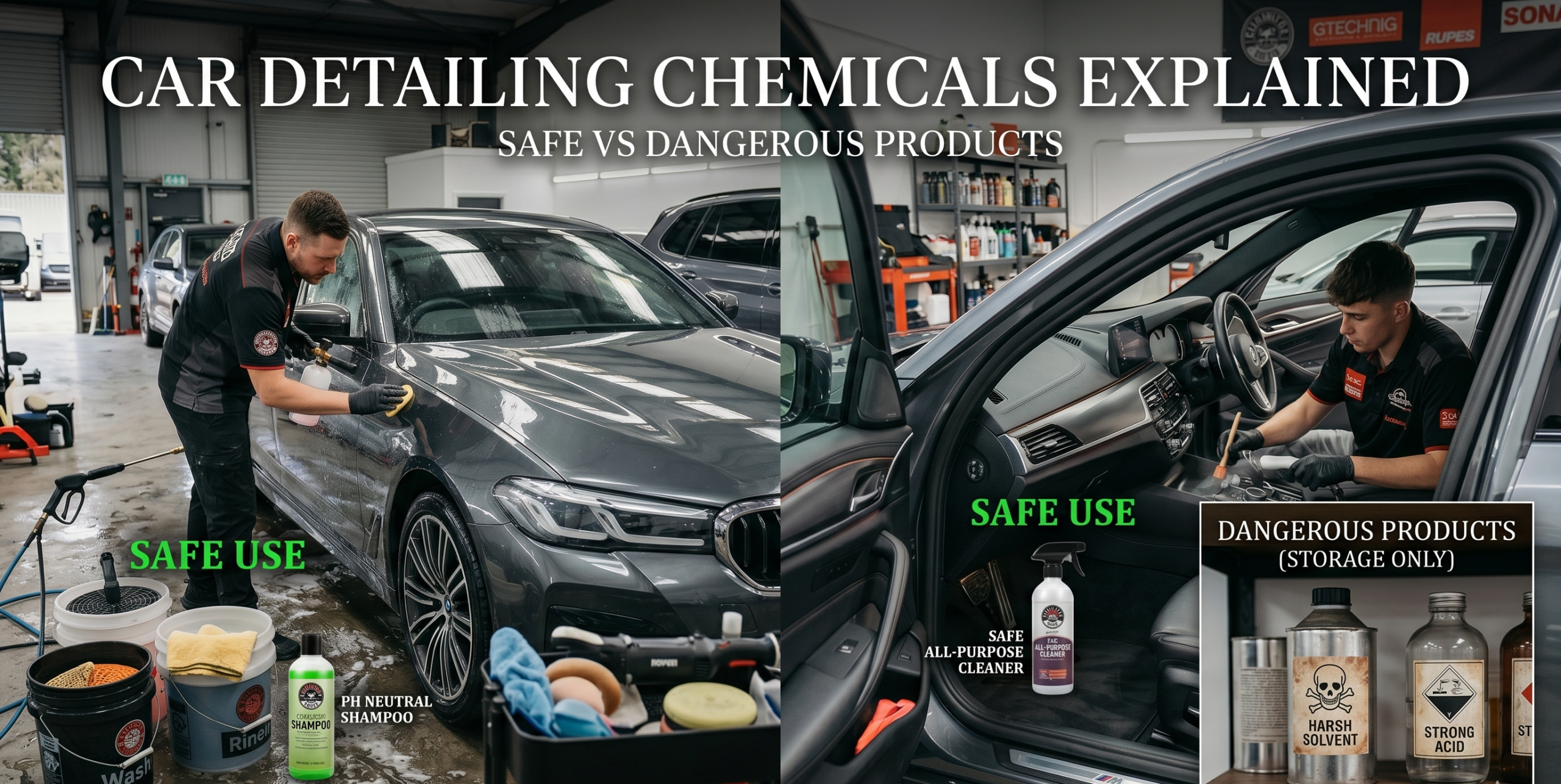
Understanding car detailing chemicals is one of the most overlooked parts of keeping a vehicle clean. Most people grab whatever product looks good on the shelf, not realizing some formulas strip protective coatings, burn skin, or release toxic fumes in enclosed spaces.
Car detailing chemicals fall into two camps: products designed to clean and protect, and products that, when misused or combined, cause real damage. Knowing the difference saves your paint, your lungs, and your wallet.
What Makes a Car Detailing Chemical Safe or Dangerous?
Safety in detailing chemicals depends on four things:
- pH level: highly acidic or highly alkaline products eat through surfaces fast
- Chemical concentration: a diluted formula safe for paint can burn bare metal at full strength
- Ventilation requirements: Some products release vapors that accumulate in closed garages
- Surface compatibility: a product safe on glass can permanently stain rubber or plastic trim
Most professional-grade products list a pH range on the label. Consumer products often skip this, which is why understanding the ingredient categories matters more than trusting brand marketing.
pH Scale and Why It Matters in Detailing
The pH scale runs from 0 (most acidic) to 14 (most alkaline), with 7 being neutral.
- pH 1–3: Wheel acid cleaners, iron removers, heavy decontamination sprays. Dissolve brake dust and mineral deposits fast. Dangerous on painted surfaces and bare skin without gloves.
- pH 4–6: Mild acidic shampoos, some bug and tar removers. Safer on paint but still requires rinsing thoroughly.
- pH 7: Neutral pH car shampoos. Safest option for regular washing. Won’t strip wax or sealants.
- pH 8–10: All-purpose cleaners (APCs), engine degreasers, interior cleaners. Effective on grease and grime. Can dull matte finishes and damage leather if left on too long.
- pH 11–14: Heavy-duty degreasers, industrial fallout removers. Professional use only. Neutralize immediately after use.
A neutral shampoo like Chemical Guys Mr. Pink or Meguiar’s Gold Class sits at pH 7 and is safe for every wash. An APC like Meguiar’s Super Degreaser used undiluted at pH 12+ will strip wax, dull plastics, and irritate skin on contact.
Car Wash Soaps and Shampoos — Safe for Every Use
Regular car shampoos are among the safest detailing products available. They are pH-neutral, biodegradable in most cases, and formulated specifically to lift dirt without breaking the bond between paint and protective coatings.
What to look for:
- pH-neutral formula (confirmed on label or product data sheet)
- Lubricating agents to reduce swirl marks during washing
- No added wax if you plan to apply a separate sealant or coating
Avoid dish soap like Dawn. It is formulated to strip grease from dishes, and it does the same to automotive wax, sealants, and ceramic coatings. A single wash with dish soap can remove months of paint protection.
The American Chemical Society has published extensively on surfactant chemistry, and the mechanism is the same: dish detergents use aggressive surfactants that do not discriminate between kitchen grease and car wax.
Iron Removers and Fallout Removers — Handle With Care
Iron removers contain active compounds, typically thioglycolic acid or ammonium thioglycolate, that react chemically with iron particles embedded in paint and wheels. The reaction turns the product purple or red as it binds to the iron, making it easy to see where contamination exists.
These products are effective but require precautions:
- Always use nitrile gloves. The active compounds cause skin irritation within minutes of contact.
- Work in a shaded area. Direct sunlight accelerates the reaction and can cause staining before you rinse.
- Never use on bare aluminum wheels without checking compatibility first. Acid-based iron removers can pit and etch uncoated aluminum.
- Rinse thoroughly within the recommended dwell time — usually 3 to 5 minutes. Leaving it on longer does not clean better; it damages the clear coat.
Brands like CarPro IronX and Koch Chemie Ferrosol are industry standards. Both carry safety data sheets (SDS) that detail exactly what protective equipment is needed.
Wheel Cleaners — The Most Misused Product Category
Wheel cleaners split into three types:
Acid-based cleaners: Fastest at removing brake dust and road grime. pH can drop to 1–2. These should never contact painted surfaces, rubber seals, or plastic trim. Even overspray on a brake caliper can cause pitting on some finishes. Always rinse the surrounding area before applying.
Alkaline cleaners: pH 9–12. Safer on painted and coated wheels. Less aggressive on brake dust compared to acid-based options, but safer for regular use.
pH-neutral wheel cleaners: Mildest option. Safe for all wheel types, including polished and anodized finishes. It requires more agitation to remove heavy contamination.
For coated, polished, or chrome wheels, always choose pH-neutral. For steel or painted factory wheels with heavy brake dust buildup, a diluted alkaline cleaner is the safest effective option.
Tar and Bug Removers — Solvent-Based Products
Tar removers and bug removers use petroleum-based solvents — typically d-limonene, mineral spirits, or naphtha to dissolve bonded organic material that water alone cannot remove.
These are safe on paint in short contact times, but cause problems when:
- Left on bare plastic trim for extended periods (can cause fading and staining)
- Used on rubber seals repeatedly (degrades rubber over time)
- Applied in enclosed spaces without ventilation (solvent vapors accumulate quickly)
The National Institute for Occupational Safety and Health (NIOSH) classifies prolonged naphtha exposure as a health hazard affecting the central nervous system. For occasional detailing in a well-ventilated driveway, the risk is minimal. For professional detailers working daily in enclosed bays, ventilation equipment is non-negotiable.
Apply tar remover, let it dwell for 60 seconds, and wipe off with a clean microfiber. Never let solvent-based products fully dry on a surface.
All-Purpose Cleaners (APCs) — Versatile but Easy to Misuse
An APC is one of the most useful chemicals in detailing and one of the easiest to ruin surfaces with if used at the wrong dilution.
Most APCs come concentrated at pH 11–13 and require dilution ratios of 1:10 to 1:30, depending on the surface:
- Engine bay and undercarriage: 1:5 to 1:10
- Door jambs and wheel wells: 1:10
- Interior plastics and fabric: 1:20 to 1:30
- Leather: Use a dedicated leather cleaner instead. APCs at any dilution can dry out and crack leather over time.
Meguiar’s Super Degreaser and Gyeon Q2M Tar diluted to the correct ratio are safe and effective. Full-strength APC sprayed on an interior headliner or a convertible soft top can cause permanent discoloration.
Always test a diluted APC on a hidden area first. Dwell time on interior surfaces should be 30 to 60 seconds maximum before wiping.
Interior Cleaners — What’s Safe Inside Your Car
Interior surfaces, such as fabric, leather, vinyl, alcantara, and plastic, each respond differently to cleaning chemicals.
Fabric and carpet cleaners typically use mild alkaline surfactants and enzymatic compounds that break down organic stains. These are safe when used as directed. Avoid saturating the carpet to the point that moisture reaches the backing, which promotes mold growth.
Leather cleaners should be pH-neutral or slightly acidic (pH 5–7) to match the natural chemistry of leather. Products outside this range strip the protective topcoat and dry out the grain. After cleaning, always follow with a leather conditioner containing lanolin or similar conditioning agents to restore moisture.
Vinyl and plastic protectants — avoid silicone-based “shine” sprays on dashboards. They look good for a day, attract dust, and, over repeated applications, leave a greasy buildup. Water-based protectants from brands like 303 Products provide UV protection without silicone residue.
The Environmental Protection Agency (EPA) has noted that certain silicone-based aerosols contribute to indoor air quality issues in enclosed vehicles.
Polishes and Compounds — Abrasives That Need Precision
Paint polish and cutting compound are not chemicals in the traditional sense — they work through controlled abrasion using diminishing abrasive particles. But they are frequently misused and damage paint when applied incorrectly.
- Cutting compounds (heavy cut): Remove deep scratches, heavy oxidation, and sanding marks. Aggressive enough to permanently remove clear coat if overworked.
- Polishes (medium to light cut): Refine surface after compound, remove light swirls and water spots.
- Finishing polishes: Least abrasive. Used before applying wax or coating to maximize gloss.
The key safety concern with polishes and compounds is heat buildup. Using a dual-action (DA) polisher incorrectly — too slow an arm movement, too much pressure, or working a panel too long — generates heat that can burn through thin clear coat on hoods and roofs.
Follow the manufacturer’s recommended machine speed and use overlapping passes at walking speed. Professionals use products like Menzerna Heavy Cut Compound 400 or Rupes Uno Pure, but require practice before using them on a daily driver.
Waxes, Sealants, and Ceramic Coatings — Protection Layer Chemistry
Carnauba wax is natural, derived from Brazilian palm leaves. It produces a warm, deep gloss and is completely safe on all painted surfaces. It lasts 4 to 8 weeks, depending on weather exposure—no safety concerns beyond standard dust contact during application.
Paint sealants use synthetic polymers that bond to the clear coat and last 3 to 6 months. They are safe to apply by hand or machine. Avoid getting sealant on rubber trim — it leaves white residue that is difficult to remove.
Ceramic coatings contain silicon dioxide (SiO2) or titanium dioxide (TiO2) in a carrier solvent. The carrier solvent — usually isopropanol or a proprietary blend — evaporates during cure, leaving a hard glass-like layer. Application requires:
- Proper ventilation (the carrier solvent produces fumes during application and initial cure)
- Nitrile gloves to prevent skin sensitization
- A dust-free environment (high spots from ceramic coating contaminated with dust cure into rough, expensive-to-remove deposits)
Consumer-grade ceramic coatings like Gtechniq Crystal Serum Light or CarPro Cquartz Lite are more forgiving than professional coatings. Professional-grade products like Gtechniq Crystal Serum Ultra require controlled conditions and trained application.
Glass Cleaners — What’s Safe on Auto Glass
Standard household glass cleaners containing ammonia are not safe for tinted windows. Ammonia degrades the tint film over time, causing it to bubble, purple, and peel. This applies to both aftermarket tint and factory-applied tint.
Use an ammonia-free glass cleaner for all automotive glass. Sprayway Glass Cleaner and Invisible Glass are commonly recommended and ammonia-free. Isopropyl alcohol (IPA) diluted to 70% in water also works well as a decontamination step before ceramic coating glass.
For water spot removal on glass, a dedicated water spot remover containing oxalic acid is effective. Apply, work in small circular motions, rinse, and follow with a glass sealant for future protection.
Chemicals You Should Never Mix in Detailing
Some product combinations produce dangerous reactions:
- Bleach + ammonia-based products → produce chloramine gas, which causes respiratory damage
- Acid-based wheel cleaner + alkaline APC → neutralization reaction creates heat and can splash
- Iron remover + acidic wheel cleaner → unstable reaction, reduced effectiveness of both products
- Solvent-based tar remover directly on freshly applied wax → dissolves the wax immediately
Always read product labels. When switching from one chemical to another on the same surface, rinse with water between applications.
How to Store Car Detailing Chemicals Safely?
- Keep chemicals in their original containers with lids fully sealed.
- Store away from direct sunlight and heat sources — solvent-based products are flammable.
- Keep acids and alkalines on separate shelves.
- Dispose of expired or separated products through local hazardous waste collection, not down the drain.
The Occupational Safety and Health Administration (OSHA) provides chemical storage guidelines under its Hazard Communication Standard (HazCom), which applies directly to detailing products in a professional setting.
Final Thoughts on Car Detailing Chemicals
Car detailing chemicals are not all equal. A pH-neutral shampoo and a wheel acid cleaner both clean vehicles — but require completely different handling, protective gear, and safety awareness. The difference between a safe product and a dangerous one is often just concentration, dwell time, or surface compatibility.
