

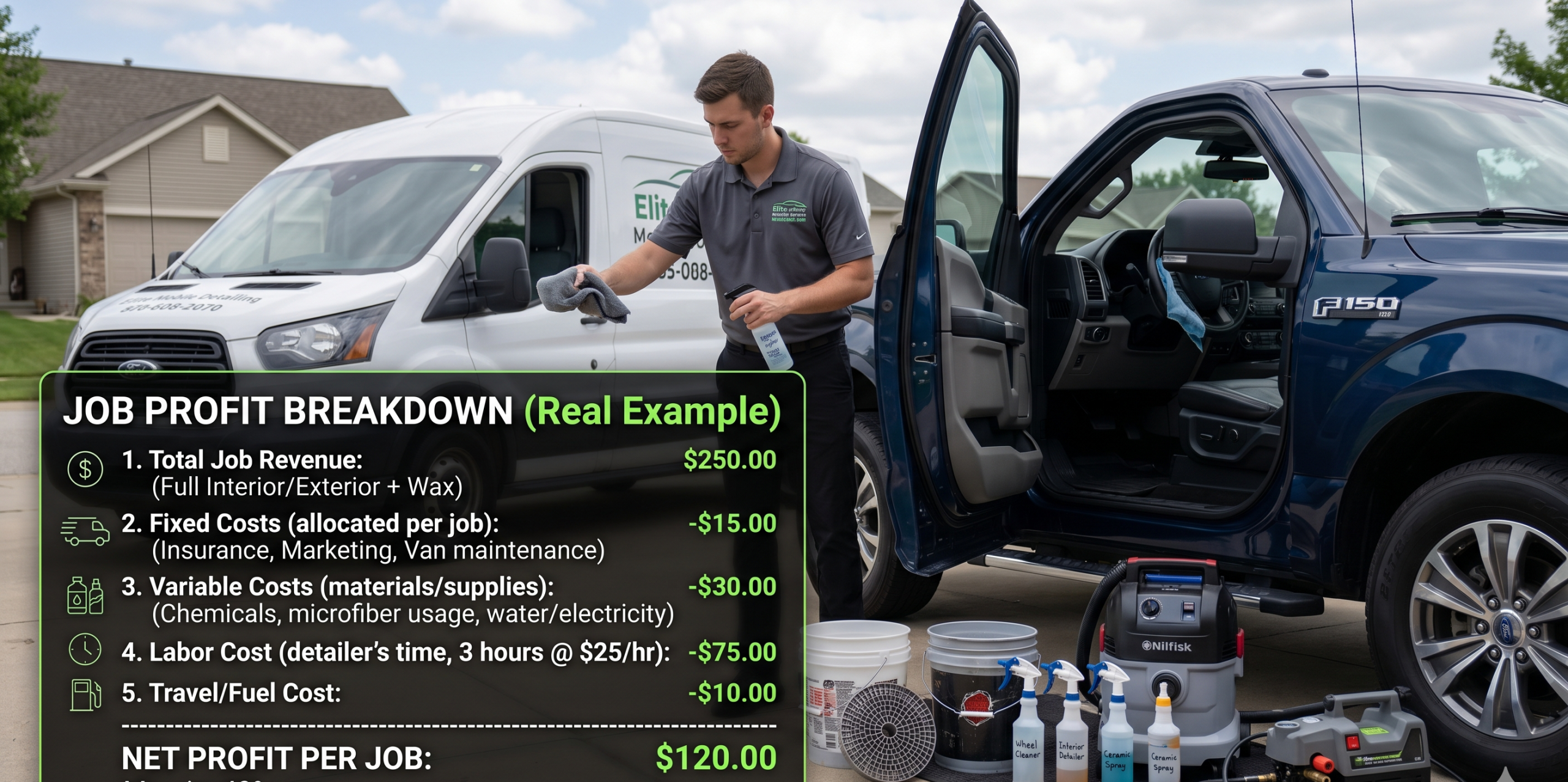
Many mobile auto detailing business owners work long, grueling hours in driveways, yet feel completely broke at the end of the month. They look at a $200 invoice and assume they just made $200. This common mistake leaves zero room for sustainable growth.
To build a thriving business, you must understand the difference between revenue and cash in your pocket. Revenue is the total cash you collect from a client. Profit is what remains after every single expense is paid.
When you learn how mobile detailers calculate profit per job, you protect your business from underpricing. You stop guessing your rates and start setting prices based on hard math.
How Mobile Detailers Calculate Profit Per Job: The Core Formula
To determine your true financial return on an individual project, you must subtract all variable and direct costs from the total service price.
The foundational equation is simple: Gross Profit equals Service Revenue minus Direct Job Costs.
Direct job costs include everything consumed or spent to complete that specific service. For a mobile operator, this splits into three clear buckets:
- Chemicals and Consumables: Every ounce of ceramic coating, wheel cleaner, car soap, and microfiber towel deteriorates.
- Labor Costs: The hourly wage paid to an employee, or the baseline value of your own time.
- Transportation and Fuel: The cost of gas and wear on your work truck or van to travel to the client’s home or office.
By tracking these elements, you find your gross profit. To take it a step further, you calculate your net profit margin by subtracting a portion of your fixed monthly expenses, like commercial liability insurance and booking software.
The True Costs Behind a Single Mobile Detailing Job
Before looking at a real breakdown, we must analyze the specific expenses incurred every time you open your van doors.
1. The Real Cost of Detailing Chemicals
Detailers often overpay by buying small retail bottles instead of purchasing concentrates in bulk. To find your exact product cost, break down the purchase price into ounces.
You can calculate this by dividing the total bottle price by the total ounces in the bottle.
If a gallon of concentrated wheel cleaner costs $32, that is 128 ounces of raw product, making it $0.25 per ounce. If you dilute it 4:1, your cost drops drastically.
Most standard interior and exterior jobs consume between $5 and $15 in chemical products.
2. Factoring in Labor Rates
Even if you are a solo operator, you cannot count labor as free profit. If you do not assign a cost to your time, you are working a job, not running a business. Base your labor cost on what it would cost to hire a skilled technician to do the job for you.
According to employment data from the U.S. Bureau of Labor Statistics, professional automotive cleaners earn a significant hourly wage that must be reflected in your baseline pricing.
3. Travel and Transportation Expenses
Mobile detailing requires driving heavy equipment and water tanks directly to the customer. Fuel consumption increases when towing a trailer or hauling a 100-gallon water tank.
You must calculate the round-trip distance and divide it by your vehicle’s average fuel economy to find the exact fuel cost per job.
Real Example Breakdown: A Full Interior and Exterior Detail
Let us look at a realistic scenario for a solo mobile detailer servicing a mid-sized SUV. We will trace every cent from the initial booking to the final net margin.
The Project Parameters
- Vehicle Type: Mid-sized Ford Explorer (SUV Multiplier applied).
- Service Provided: Full interior steam clean, leather treatment, multi-stage wash, and paint sealant.
- Total Price Charged: $250.
- Time to Complete: Exactly 3 hours.
- Travel Distance: 15 miles round trip.
Step-by-Step Direct Expense Calculations
1. Chemical and Product Breakdown
A professional job consumes tiny amounts of multiple products. Here is how the product usage adds up:
| Product Type | Quantity Used | Cost Per Ounce/Unit | Total Cost |
|---|---|---|---|
| Decontamination Snow Foam | 3 oz | $0.30 / oz | $0.90 |
| Wheel & Tire Cleaner (Diluted) | 8 oz | $0.12 / oz | $0.96 |
| Interior All-Purpose Cleaner | 6 oz | $0.15 / oz | $0.90 |
| Premium Leather Conditioner | 2 oz | $0.75 / oz | $1.50 |
| Silica Paint Sealant | 1.5 oz | $2.00 / oz | $3.00 |
| Microfiber Towel Wear & Tear | 2 Towels | $1.00 / retirement rate | $2.00 |
| Total Chemical Cost | — | — | $9.26 |
2. Labor Cost Calculation
To keep the math clean, we will value professional labor at $25 per hour. Since this SUV requires 3 hours of focused labor, multiplying 3 hours by $75 gives us a total labor cost of $75.00.
3. Travel and Gas Calculation
The service van gets roughly 15 miles per gallon due to the weight of the generator, pressure washer, and water tank. If gas costs $3.50 per gallon, driving 15 miles consumes exactly one gallon of fuel.
- Total Travel Cost: $3.50
The Final Job Profit Summary
Now we combine all the pieces of our real example breakdown to see what the business actually earned.
To find the total direct costs, we add $9.26 for chemicals, $75.00 for labor, and $3.50 for travel, which equals $87.76.
Subtracting the total direct costs from the total revenue gives us the gross profit for this single job: $250.00 minus $87.76 leaves us with a gross profit of $162.24.
To find the gross profit percentage, divide the gross profit by the total revenue and multiply by 100. This calculation results in a healthy 64.89% gross profit margin.
If you are a solo operator who does not pay out an employee wage yet, you take home both the labor rate and the profit, resulting in a total cash inflow of $237.24 from a single booking.
How Fixed Monthly Overhead Impacts Your Profits?
While the gross profit per job looks incredibly lucrative, you cannot forget about your fixed business expenses. These are the monthly bills you must pay regardless of whether you wash one car or one hundred cars.
Common fixed costs for mobile detailers include:
- Commercial General Liability Insurance: Protects you if you accidentally damage a vehicle’s paint or electronics.
- CRM and Booking Software: Manages your customer schedules, invoices, and automated text reminders.
- Marketing & Local Ads: The money spent on local search visibility, flyers, and social media promotions to keep your schedule full.
- Equipment Maintenance: Monthly allocations for replacing pressure washer pump oil, generator spark plugs, and polisher pads.
If your total monthly fixed expenses equal $600, and you complete 30 jobs per month, every single job must absorb $20 of that overhead.
Subtracting that $20 overhead share from your $162.24 gross profit leaves a final net profit of $142.24. Accounting for overhead changes your final numbers, lowering your true net profit margin to 56.9%.
3 Critical Pricing Strategies to Boost Your Profit Per Job
If your calculations show that your margins are falling below the 50% mark, you need to alter your operational strategy immediately. Use these three professional methods to protect your bottom line.
Use Vehicle Size Multipliers
Never charge the same flat fee for a compact two-door coupe and a massive extended-cab pickup truck.
Larger vehicles require significantly more product, extra microfiber towels, and hours of intensive labor. Implement a clear multiplier system based on your base sedan rate:
- Sedans / Coupes: 1.0x (Base Price).
- Crossovers / Small SUVs: 1.2x Base Price.
- Full-Sized SUVs / Trucks: 1.4x Base Price.
- Commercial Vans / Lifted Trucks: 1.6x Base Price.
Upsell High-Margin Add-Ons
The basic steps of washing, vacuuming, and wiping down a dashboard take up the bulk of your time. The best way to increase profit without driving to a new location is by upselling premium add-ons while you are already on-site.
Services like headlight restoration, engine bay cleaning, and glass ceramic treatments consume minimal chemicals and require very little extra time, yet they command premium rates.
Buy Concentrated Chemicals in Bulk
Purchasing ready-to-use spray bottles from local auto parts stores destroys your margins. Invest in professional, commercial-grade concentrates from reputable supply companies.
Buying a 5-gallon bucket of car shampoo or interior cleaner allows you to dilute the product with distilled water, dropping your chemical cost per application from dollars to mere pennies.
Tracking Metrics for Long-Term Business Health
To keep your mobile detailing business highly profitable, make it a habit to log your numbers weekly. Use a basic digital spreadsheet to track your revenue, travel miles, and product orders.
Knowing exactly how mobile detailers calculate profit per job changes how you look at your business.
It gives you the confidence to raise your prices, walk away from low-paying customers, and build a sustainable brand that generates real wealth. Stop guessing your numbers and start calculating your success.
