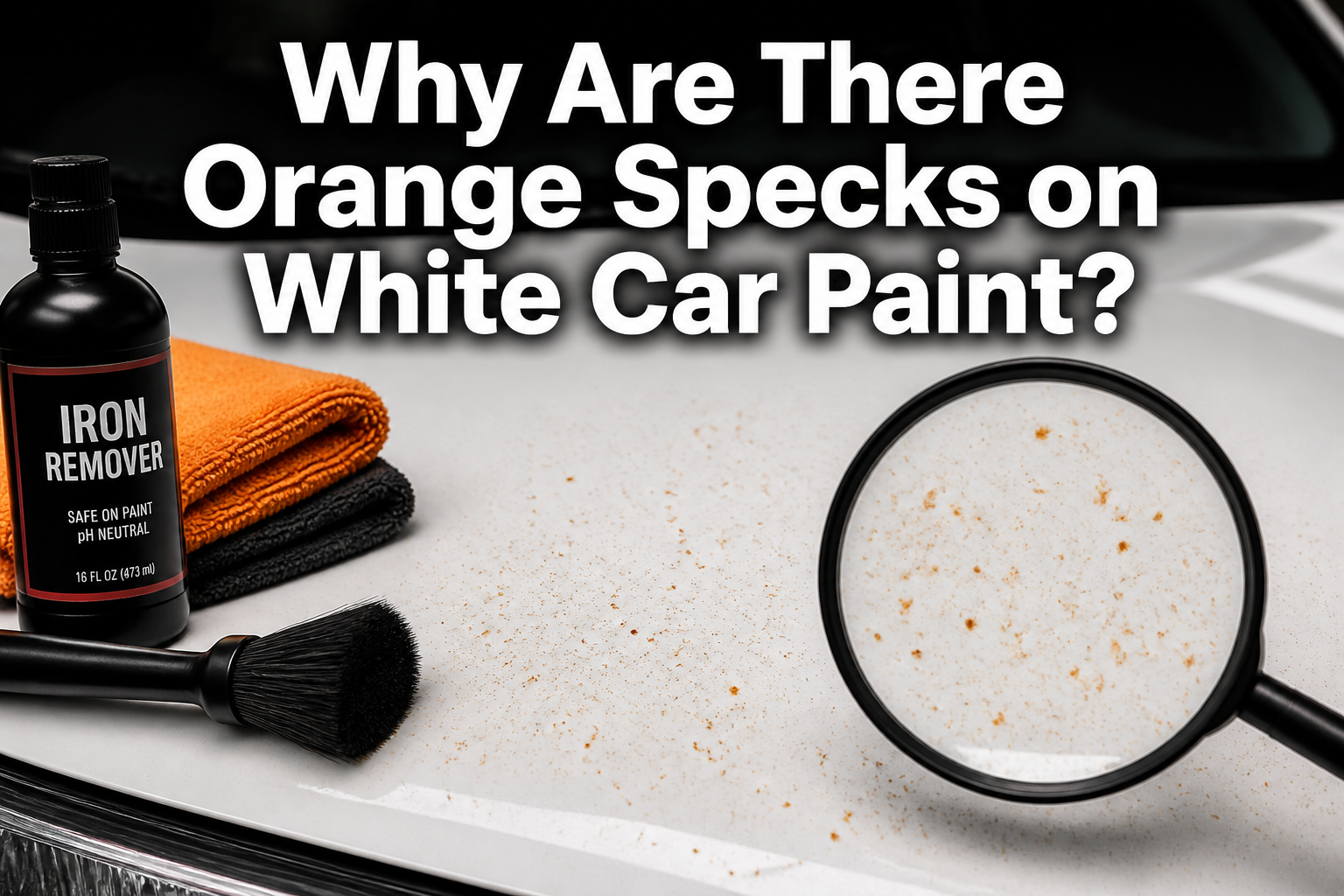
Orange specks on white car paint are typically iron particles from brake dust, rail dust, or industrial fallout that have bonded to the paint surface and begun to oxidize (rust). These metallic contaminants embed into the clear coat and turn orange-brown when exposed to moisture and oxygen, creating visible spots that standard washing cannot remove.
What Causes Orange Specks on White Car Paint?
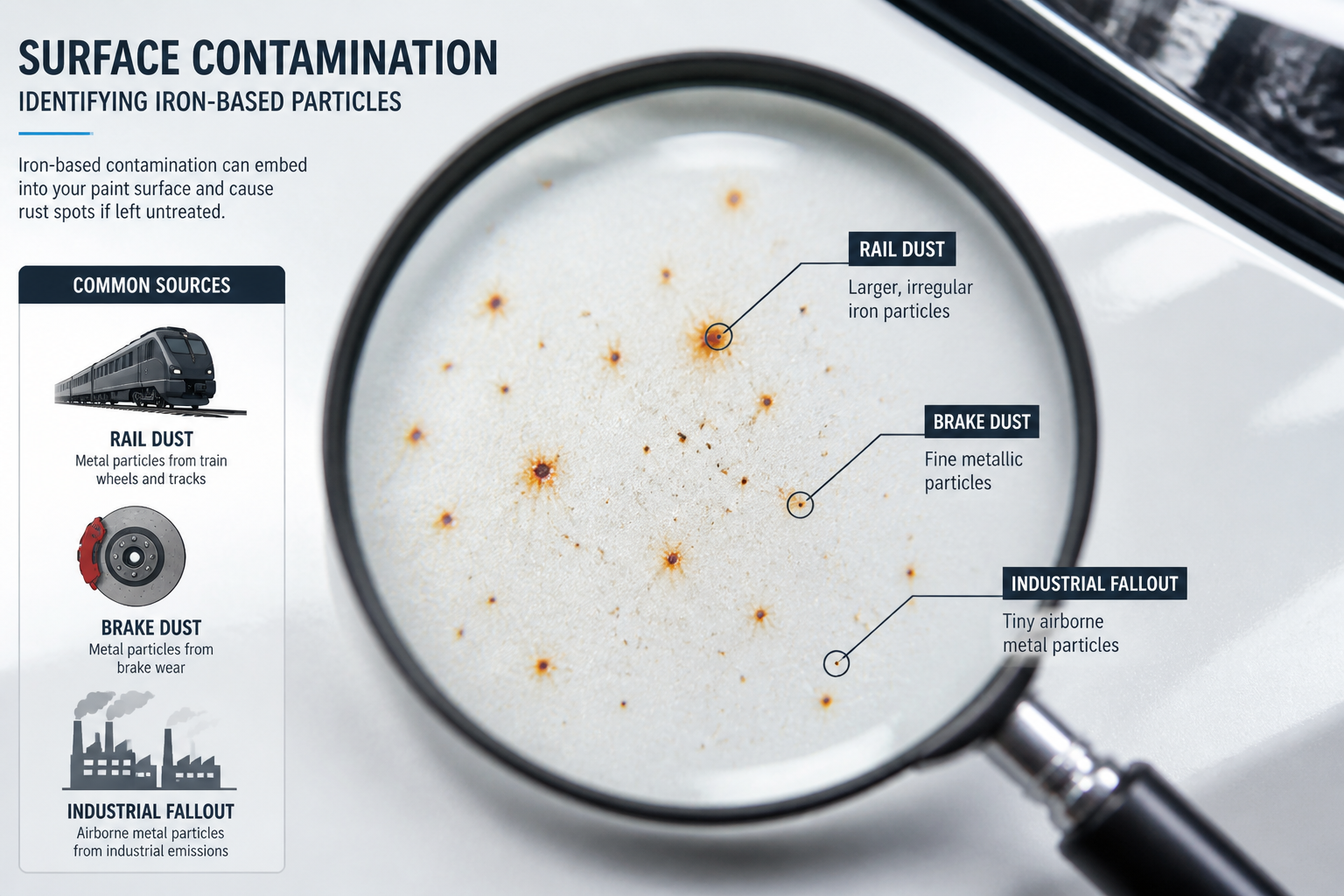
Orange specks on white car paint result from iron particles that land on the vehicle’s surface and oxidize over time. These microscopic metal fragments come from several sources and become embedded in the paint’s porous clear coat layer.
The most common sources include:
Brake Dust Contamination
- Generated when brake pads compress against rotors during stopping.
- Contains iron particles that become airborne and settle on nearby surfaces.
- Affects all vehicles, but is more noticeable on white paint.
- Increases in heavy traffic areas and stop-and-go driving conditions.
Rail Dust Exposure
- Created by the friction between train wheels and steel tracks.
- Can travel several miles from railway lines.
- Particularly problematic for cars parked near train routes.
- Often affects entire neighborhoods near rail corridors.
Industrial Fallout
- Originates from manufacturing facilities, construction sites, and metalworking operations.
- Contains various metal particles, including iron, steel, and aluminum.
- More concentrated in industrial zones and urban areas.
- Weather patterns can carry particles significant distances.
Choose immediate cleaning if you notice orange specks appearing within days of exposure, as fresh contamination removes more easily than aged particles.
How Do Orange Specks Form on Car Paint?
Orange specks develop through a specific oxidation process that occurs when iron particles interact with moisture and oxygen on the paint surface.
The Formation Process:
- Initial Contact: Microscopic iron particles land on the paint surface.
- Embedding: Particles settle into the clear coat’s microscopic pores.
- Moisture Exposure: Rain, dew, or humidity provides water for oxidation.
- Rust Development: Iron particles begin oxidizing, turning orange-brown.
- Visible Contamination: Rust spots become large enough to be seen with the naked eye.
Timeline Factors:
- Fresh contamination may show an orange color within 24-48 hours in humid conditions.
- Dry climates slow the oxidation process, but don’t prevent it entirely.
- Temperature fluctuations accelerate the rusting process.
- Salt exposure from winter roads or coastal areas speeds contamination.
Common mistake: Assuming orange specks are paint defects rather than contamination, leading to unnecessary touch-up paint applications instead of proper decontamination.
Can You Remove Orange Specks from White Car Paint?
Yes, orange specks can be successfully removed from white car paint using appropriate decontamination methods, provided the contamination hasn’t permanently etched into the clear coat.
Effective Removal Methods:
Clay Bar Treatment
- Most reliable method for embedded iron particles.
- Works by mechanically lifting contaminants from paint pores.
- Requires proper lubrication to prevent paint scratching.
- Best for light to moderate contamination levels.
Iron Remover Products
- Chemical solutions that dissolve iron particles through chelation.
- Turn purple when reacting with iron contamination.
- Safe for paint, wheels, and glass surfaces.
- Ideal for heavy contamination or hard-to-reach areas.
Professional Decontamination
- Combines multiple techniques for complete removal.
- Includes paint correction if etching has occurred.
- Recommended for severe or long-term contamination.
- Often includes protective coating application.
Edge case: Contamination left untreated for months may require paint correction or touch-up if iron particles have etched through the clear coat into the base paint layer.
How Often Should You Remove Orange Specks?
Regular decontamination every 3-6 months prevents orange specks from becoming permanent stains on white car paint, though frequency depends on environmental exposure and driving conditions.
Recommended Schedule:
- High-risk areas (near railways, industrial zones): Every 2-3 months.
- Urban environments with heavy traffic: Every 3-4 months.
- Suburban/rural areas with minimal exposure: Every 4-6 months.
- Garage-kept vehicles with limited exposure: Every 6 months.
Signs Requiring Immediate Attention:
- Orange specks are visible from 3+ feet away.
- Rough texture when running a hand over the paint surface.
- Specks that don’t wash off with regular car soap.
- Contamination covering more than 25% of the paint surface.
Choose more frequent decontamination if you regularly drive in construction zones, live near industrial facilities, or park outdoors in areas with heavy brake dust accumulation.
What Products Work Best for Orange Speck Removal?
The most effective products for removing orange specks from white car paint include dedicated iron removers, quality clay bars, and proper lubrication systems designed for automotive decontamination.
Top Product Categories:
Iron Remover Solutions
- CarPro Iron X and Chemical Guys Decon Pro are industry standards.
- Spray-on application with 5-10 minute dwell time.
- Purple color change indicates active iron dissolution.
- Safe for regular use without paint damage.
Clay Bar Systems
- Fine-grade clay works best for automotive paint.
- Requires a dedicated clay lubricant or a quality car soap solution.
- Mothers California Gold and Meguiar’s offer reliable options.
- Replace clay when it becomes heavily contaminated.
Combination Approaches
- Start with an iron remover to dissolve embedded particles.
- Follow with clay bar treatment for remaining contamination.
- Finish with paint protection (wax or ceramic coating).
- Professional-grade products offer superior results.
Decision rule: Choose the iron remover first for heavy contamination, the clay bar only for light specks, or combination treatment for best results on severely affected white paint.
Preventing Orange Specks on White Car Paint
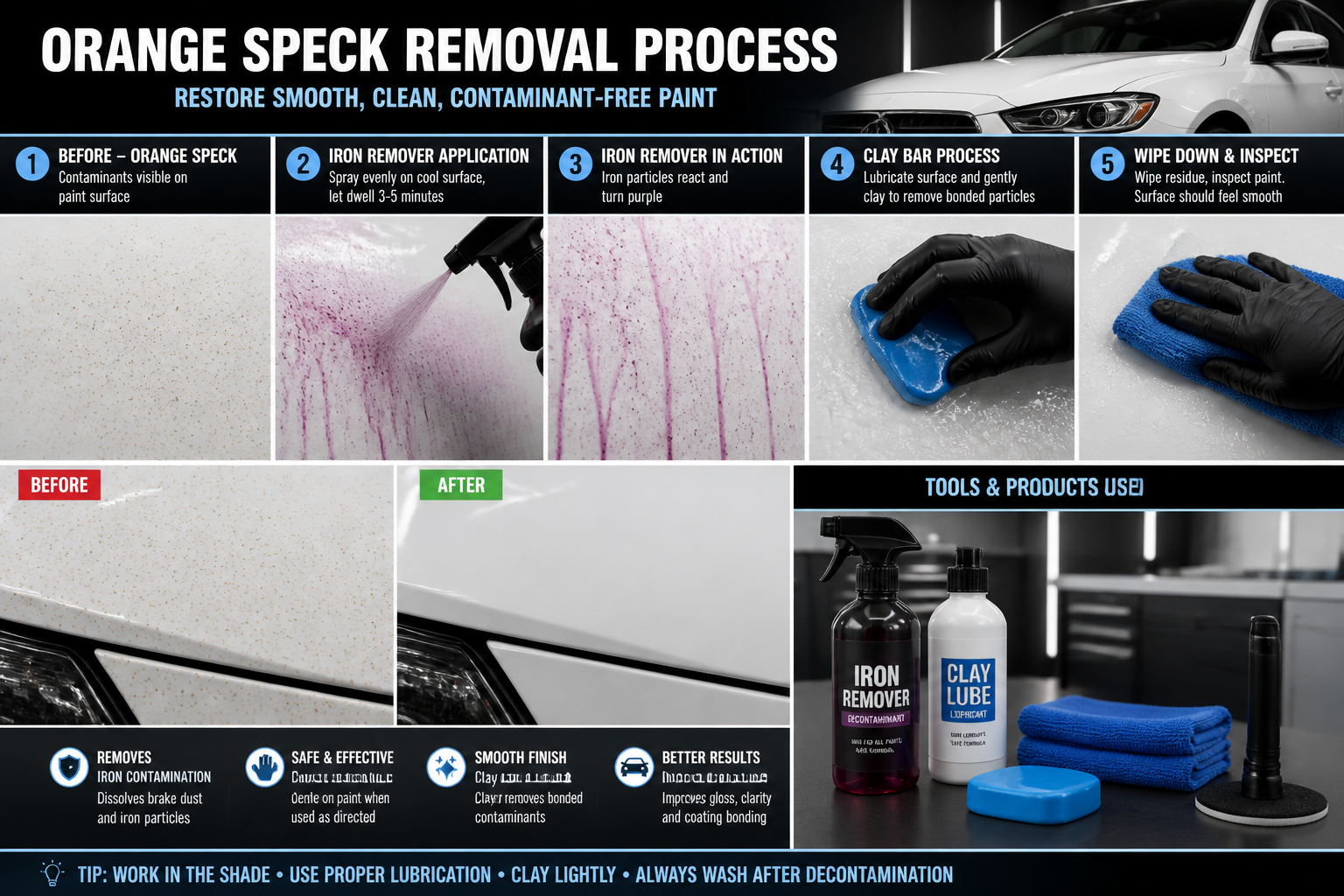
Prevention strategies significantly reduce orange speck formation on white car paint through regular maintenance, protective coatings, and smart parking choices.
Effective Prevention Methods:
Regular Washing Schedule
- Weekly washing removes particles before oxidation occurs.
- Use quality car soap with the proper two-bucket method.
- Pay attention to horizontal surfaces where particles accumulate.
- Dry thoroughly to prevent water spot formation.
Protective Coatings
- Ceramic coatings create a barrier against contaminant bonding.
- Quality car wax provides temporary protection for 2-3 months.
- Paint protection film offers ultimate defense for high-value vehicles.
- Reapply protection after each decontamination session.
Smart Parking Strategies
- Avoid parking near railway lines when possible.
- Use covered parking in industrial areas.
- Park away from heavy traffic intersections.
- Consider car covers for long-term outdoor storage.
Common mistake: Relying solely on regular washing without periodic decontamination, allowing iron particles to build up over time despite consistent cleaning efforts.
When to Seek Professional Help?
Professional automotive detailing becomes necessary when orange specks have caused permanent damage to white car paint or when contamination exceeds what standard removal methods can address.
Professional Service Indicators:
- Orange specks remain after clay bar and iron remover treatment.
- Paint feels permanently rough or textured in affected areas.
- Contamination has created visible etching or staining.
- Large surface areas require treatment (entire vehicle).
- Time constraints prevent proper DIY decontamination.
Professional Services Include:
- Paint correction to remove etching and stains.
- Machine polishing for surface restoration.
- Ceramic coating application for long-term protection.
- Complete vehicle decontamination, including wheels and glass.
Cost Considerations:
- Basic decontamination: $100-200 for sedan-sized vehicle.
- Paint correction with decontamination: $300-600, depending on damage severity.
- Full details with protection: $500-1000+ for comprehensive service.
Choose professional service if contamination covers more than 50% of the vehicle or if previous DIY attempts have been unsuccessful.
FAQ
How long does it take for orange specks to appear on white car paint?
Orange specks can appear within 24-48 hours in humid conditions once iron particles land on the paint surface and begin oxidizing.
Are orange specks permanent damage to car paint?
Orange specks are typically removable contamination, but can cause permanent etching if left untreated for several months, especially in harsh weather conditions.
Can a regular car wash remove orange specks?
No, regular car washing cannot remove orange specks because the iron particles become embedded in the clear coat and require specialized decontamination methods.
Do orange specks only affect white cars?
Orange specks affect all car colors, but they’re most visible on white paint due to color contrast. Dark-colored vehicles have the same contamination, but it’s less noticeable.
Is it safe to use an iron remover on car paint?
Yes, quality iron removers are formulated to be safe on automotive paint when used according to manufacturer instructions and rinsed thoroughly after application.
How much does professional orange speck removal cost?
Professional decontamination typically costs $100-200 for basic service, with prices increasing to $300-600 if paint correction is needed to address etching damage.
Can I prevent orange specks completely?
Complete prevention is difficult in most environments, but regular washing, protective coatings, and covered parking significantly reduce contamination levels.
What’s the difference between orange specks and paint oxidation?
Orange specks are external iron contamination that can be removed, while paint oxidation is the deterioration of the paint itself, requiring restoration or repainting.
Should I clay bar my car before or after using the iron remover?
Use an iron remover first to dissolve embedded particles, then follow with a clay bar treatment to remove any remaining contamination for best results.
How often should I check for orange specks on my white car?
Inspect your white car’s paint monthly, especially horizontal surfaces like the hood and roof, where contamination typically accumulates first.
Conclusion
Orange specks on white car paint result from iron contamination that oxidizes on the vehicle’s surface, creating visible rust-colored spots that regular washing cannot remove. Understanding the sources—brake dust, rail dust, and industrial fallout—helps car owners take preventive measures and address contamination promptly.