Interior detailing typically generates higher profit margins (60-70%) compared to full detailing services (40-50%) due to lower material costs and faster turnaround times. However, full detailing commands higher total revenue per customer, often making it more profitable in absolute dollar terms for established businesses with efficient workflows.
What Are the Profit Margins for Interior Detail vs Full Detail?
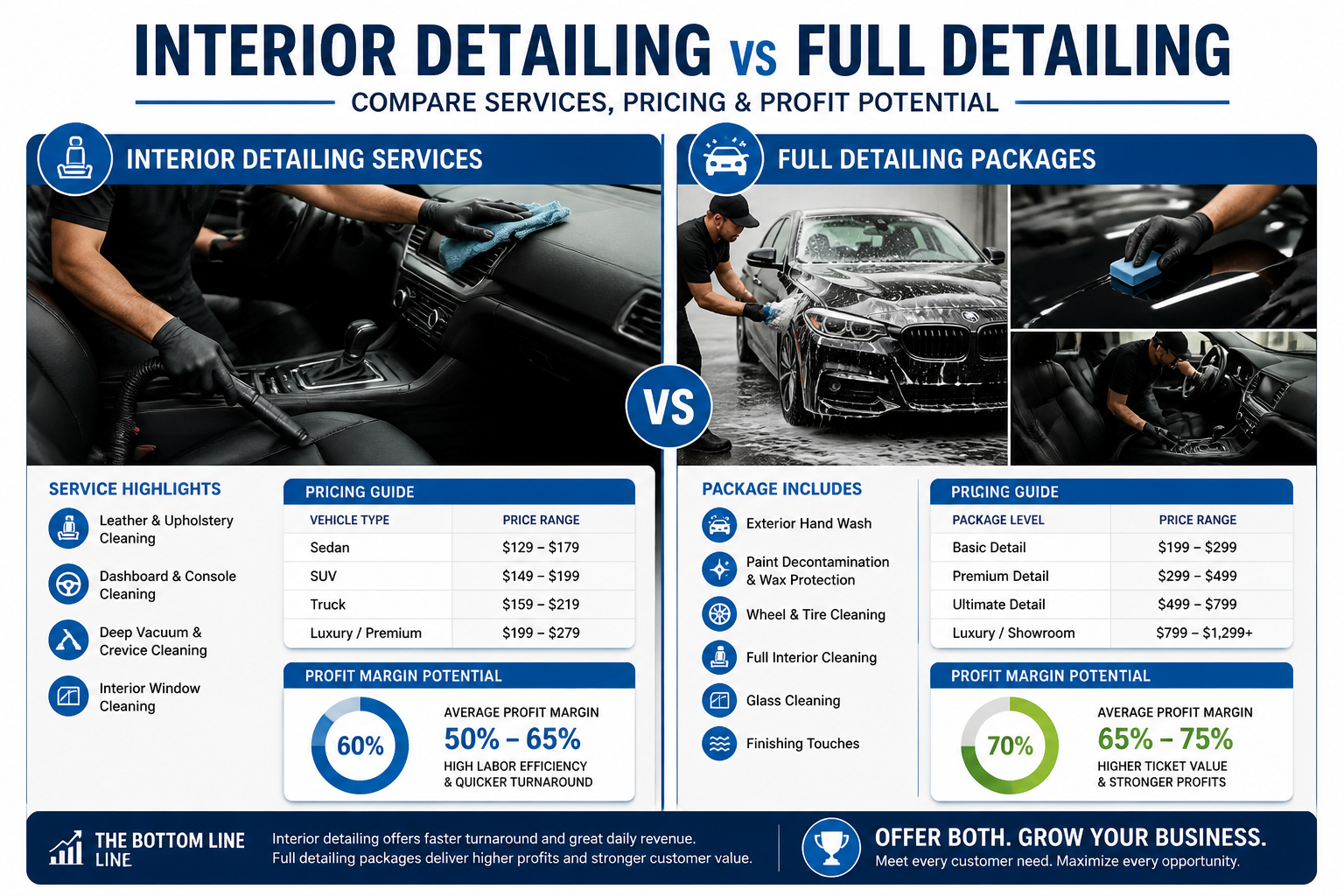
Interior detailing consistently delivers higher profit margins, typically ranging from 60-70%, while full detailing services average 40-50% margins. The difference stems primarily from material costs and labor efficiency.
Interior Detailing Profit Breakdown:
- Service price: $80-150.
- Material costs: $8-15 (cleaning products, protectants).
- Labor time: 2-3 hours.
- Net margin: 60-70%
Full Detailing Profit Breakdown:
- Service price: $200-400.
- Material costs: $25-45 (interior + exterior products, wax, polish).
- Labor time: 4-6 hours.
- Net margin: 40-50%
The higher margins in interior detailing result from concentrated value delivery. Customers pay premium prices for specialized interior cleaning, while material costs remain minimal compared to the extensive product range required for full exterior and interior services.
Key Margin Factors:
- Product costs scale disproportionately with exterior services.
- Interior work requires fewer specialized tools and chemicals.
- Weather independence reduces operational disruptions.
- Faster service cycles increase daily capacity.
How Does Revenue Per Customer Compare Between Services?
Full detailing generates significantly higher revenue per customer, typically 2-3 times more than interior-only services. This revenue advantage often compensates for lower profit margins in established operations.
Revenue Comparison:
- Interior detailing: $80-150 per service.
- Full detailing: $200-400 per service.
- Premium full packages: $400-600+ per service.
The revenue gap creates different business models. Interior detailing relies on volume and frequency, while full detailing focuses on comprehensive service value and less frequent but higher-value transactions.
Customer Lifetime Value Considerations:
- Full detailing customers typically return every 3-4 months.
- Interior detailing customers may return monthly or bi-monthly.
- Annual customer value often favors full detailing despite lower frequency.
- Upselling opportunities differ significantly between service types.
Choose interior detailing for quick market entry and high-margin operations. Select full detailing if you have sufficient capital and want to maximize revenue per transaction.
What Are the Time and Labor Efficiency Differences?
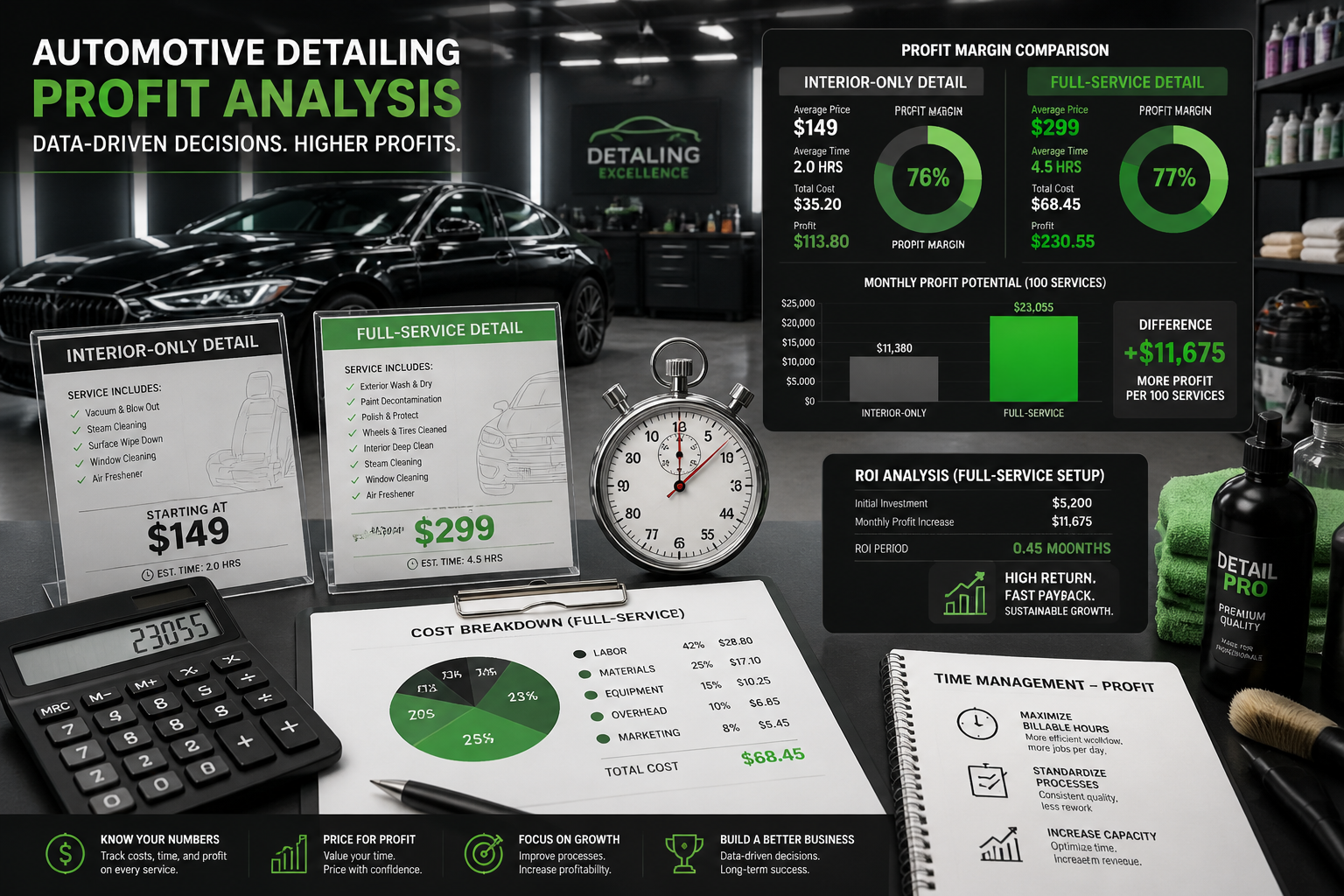
Interior detailing offers superior time efficiency, requiring 2-3 hours compared to 4-6 hours for full detailing services. This efficiency advantage directly impacts daily capacity and labor costs.
Time Efficiency Breakdown:
| Service Type | Average Time | Daily Capacity | Labor Cost/Hour |
|---|---|---|---|
| Interior Detail | 2-3 hours | 3-4 cars | $15-25 |
| Full Detail | 4-6 hours | 1-2 cars | $15-25 |
Labor Efficiency Factors:
- Interior work eliminates weather dependencies.
- Fewer setup and breakdown requirements.
- Reduced equipment transportation needs.
- Simplified quality control processes.
The time advantage allows interior detailing operations to serve more customers daily, potentially offsetting the lower per-service revenue through increased volume. Full detailing requires more skilled technicians and longer training periods.
Staffing Considerations:
- Interior detailing can utilize part-time or less experienced workers.
- Full detailing demands comprehensive training across multiple skill areas.
- Quality consistency is easier to maintain with interior-focused services.
- Employee productivity metrics favor interior specialization.
Which Service Type Has Lower Startup and Operating Costs?
Interior detailing requires significantly lower startup and operating costs, making it more accessible for new business owners. Initial investment differences can exceed $10,000-15,000 between service types.
Startup Cost Comparison:
Interior Detailing Startup:
- Basic equipment: $2,000-4,000.
- Initial inventory: $500-1,000.
- Vehicle/trailer setup: $3,000-8,000.
- Total: $5,500-13,000
Full Detailing Startup:
- Complete equipment set: $8,000-15,000.
- Extensive product inventory: $1,500-3,000.
- Professional vehicle/facility: $8,000-20,000.
- Total: $17,500-38,000
Monthly Operating Cost Differences:
- Interior services: $300-600 in supplies.
- Full services: $800-1,500 in supplies.
- Insurance costs are typically 20-30% higher for full detailing.
- Equipment maintenance costs scale with service complexity.
The lower barrier to entry makes interior detailing attractive for entrepreneurs testing market demand or operating with limited capital. Full detailing requires substantial upfront investment but offers greater revenue potential.
How Do Market Demand and Seasonality Affect Each Service?
Interior detailing experiences more stable year-round demand, while full detailing faces significant seasonal fluctuations that impact profitability patterns.
Seasonal Demand Patterns:
- Interior services maintain 70-80% consistency year-round.
- Full detailing can fluctuate 40-60% between peak and off-seasons.
- Winter months heavily favor interior-only services in cold climates.
- Spring and summer create peak demand for full detailing.
Market Positioning Advantages:
Interior Detailing:
- Appeals to busy professionals seeking convenience.
- Targets luxury vehicle owners year-round.
- Serves commercial fleets with regular maintenance needs.
- Less competition in specialized interior restoration.
Full Detailing:
- Captures special occasion and seasonal customers.
- Commands premium pricing for comprehensive service.
- Attracts car enthusiasts and collectors.
- Builds stronger customer relationships through complete care.
Weather independence gives interior detailing a competitive advantage in regions with harsh winters or extended rainy seasons. Full detailing businesses often supplement with interior-only services during off-peak periods.
What Are the Customer Acquisition and Retention Differences?
Customer acquisition costs are typically lower for interior detailing, but full detailing achieves higher retention rates and customer lifetime value.
Acquisition Characteristics:
Interior Detailing:
- Lower price point reduces purchase hesitation.
- Faster service delivery improves customer experience.
- Word-of-mouth marketing spreads more quickly.
- Social media showcases create a strong visual impact.
Full Detailing:
- Higher investment requires more trust-building.
- Comprehensive results generate stronger testimonials.
- Premium positioning attracts quality-focused customers.
- Longer sales cycles but higher conversion value.
Retention Factors:
- Interior customers return more frequently (monthly vs. quarterly).
- Full detailing creates a stronger emotional attachment to the service provider.
- Comprehensive services build deeper business relationships.
- Interior services face more price-based competition.
The acquisition strategy should align with your target market and pricing model. Interior detailing works well for volume-based customer acquisition, while full detailing suits relationship-focused business development.
Which Service Offers Better Scalability and Growth Potential?
Full detailing typically offers superior scalability and long-term growth potential, despite higher initial barriers and operational complexity.
Scalability Factors:
Interior Detailing Scalability:
- Easier to train and manage multiple technicians.
- Lower capital requirements for expansion.
- Faster market penetration in new areas.
- Simpler quality control across locations.
Full Detailing Scalability:
- Higher revenue per location supports expansion costs.
- Premium positioning enables market leadership.
- Comprehensive services create competitive moats.
- Greater opportunities for service diversification.
Growth Trajectory Considerations:
- Interior specialists often expand into full-service over time.
- Full detailing businesses can segment into specialized offerings.
- Market maturity affects growth potential differently.
- Customer base evolution influences service expansion decisions.
Choose interior detailing for rapid initial growth and market testing. Select full detailing for sustainable long-term business development and market dominance.
FAQ
Can I start with interior detailing and expand to full services later?
Yes, this is a common and effective business progression. Starting with interior detailing allows you to build skills, customer base, and capital before investing in full detailing equipment and training.
Which service type is more recession-resistant?
Interior detailing tends to be more recession-resistant due to lower price points and the fact that people still need basic car maintenance even during economic downturns.
How much can I charge for interior vs full detailing in 2026?
Interior detailing typically ranges from $80-150, while full detailing commands $200-400+. Pricing varies significantly by location, target market, and service quality level.
Do I need special certifications for either service type?
Neither requires mandatory certifications, but professional training programs can improve skills and credibility. Full detailing benefits more from formal training due to its complexity.
Which service type has better profit potential for mobile operations?
Interior detailing is generally better suited for mobile operations due to lower water requirements, reduced equipment needs, and weather independence.
How do insurance costs differ between interior and full detailing?
Full detailing typically costs 20-30% more to insure due to higher equipment values, increased liability exposure, and more complex operations.
Can I offer both services simultaneously?
Yes, many successful businesses offer both options, using interior detailing as an entry-level service and upselling to full detailing packages.
Which service builds stronger customer relationships?
Full detailing generally builds stronger relationships due to higher investment levels, comprehensive results, and longer service interactions that create more touchpoints.
How do material costs scale between the two services?
Material costs for interior detailing are typically $8-15 per service, while full detailing ranges from $25-45, making interior services more cost-efficient.
Which service type is easier to market on social media?
Both services perform well on social media, but interior detailing often creates more dramatic before/after transformations that generate higher engagement rates.
Summary
The Interior Detail vs Full Detail profitability question depends on your business goals, available capital, and market conditions. Interior detailing offers higher profit margins (60-70%), lower startup costs, and more predictable demand, making it ideal for new entrepreneurs or those seeking steady cash flow.
Full detailing provides higher revenue per customer and better long-term scalability, despite lower margins (40-50%) and higher operational complexity.