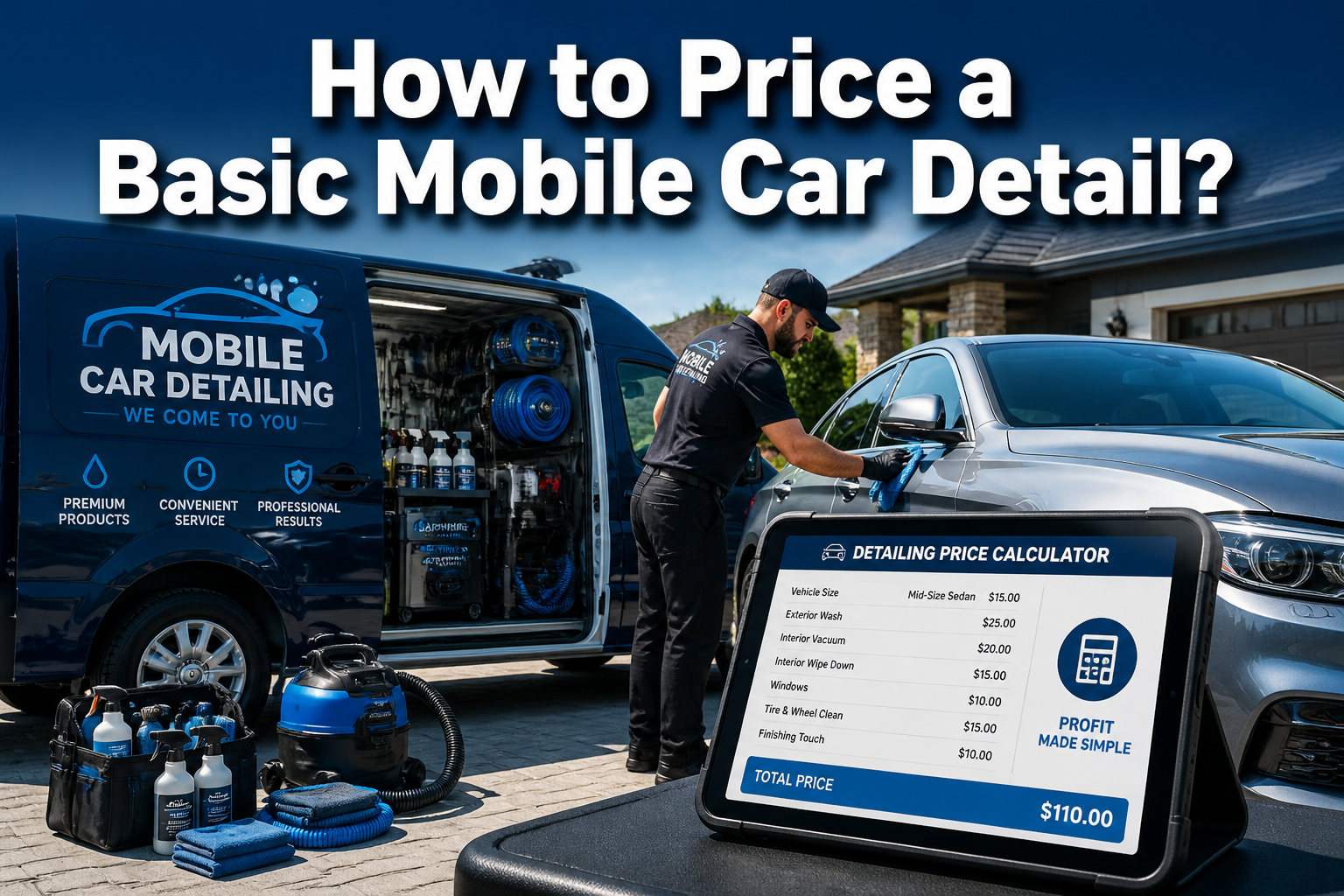
To price a basic mobile car detail, charge between $50-$120, depending on vehicle size, with compact cars at $50-70, mid-size vehicles at $70-90, and SUVs/trucks at $90-120. Factor in your costs (supplies, fuel, labor, equipment) plus desired profit margin of 40-60% to ensure profitability while staying competitive in your local market.
What Services Should a Basic Mobile Car Detail Include?
A basic mobile car detail includes exterior washing, interior vacuuming, dashboard and surface cleaning, and window cleaning inside and out. This foundational service package typically takes 1.5-2.5 hours and serves as the entry point for most mobile detailing businesses.
Essential basic services:
- Complete exterior hand wash and rinse.
- Interior vacuum (seats, carpets, floor mats).
- Dashboard and console wipe-down.
- Interior and exterior window cleaning.
- Tire and rim cleaning.
- Basic door jamb cleaning.
Common add-ons that increase value:
- Tire shine application (+$10-15).
- Basic wax or sealant (+$20-30).
- Interior protectant on vinyl/leather (+$15-20).
- Floor mat shampooing (+$10-15).
The key decision rule: include services that can be completed efficiently without specialized equipment, while offering premium add-ons that justify higher pricing for customers wanting extra protection or shine.
How Much Should You Charge to Price a Basic Mobile Car Detail?
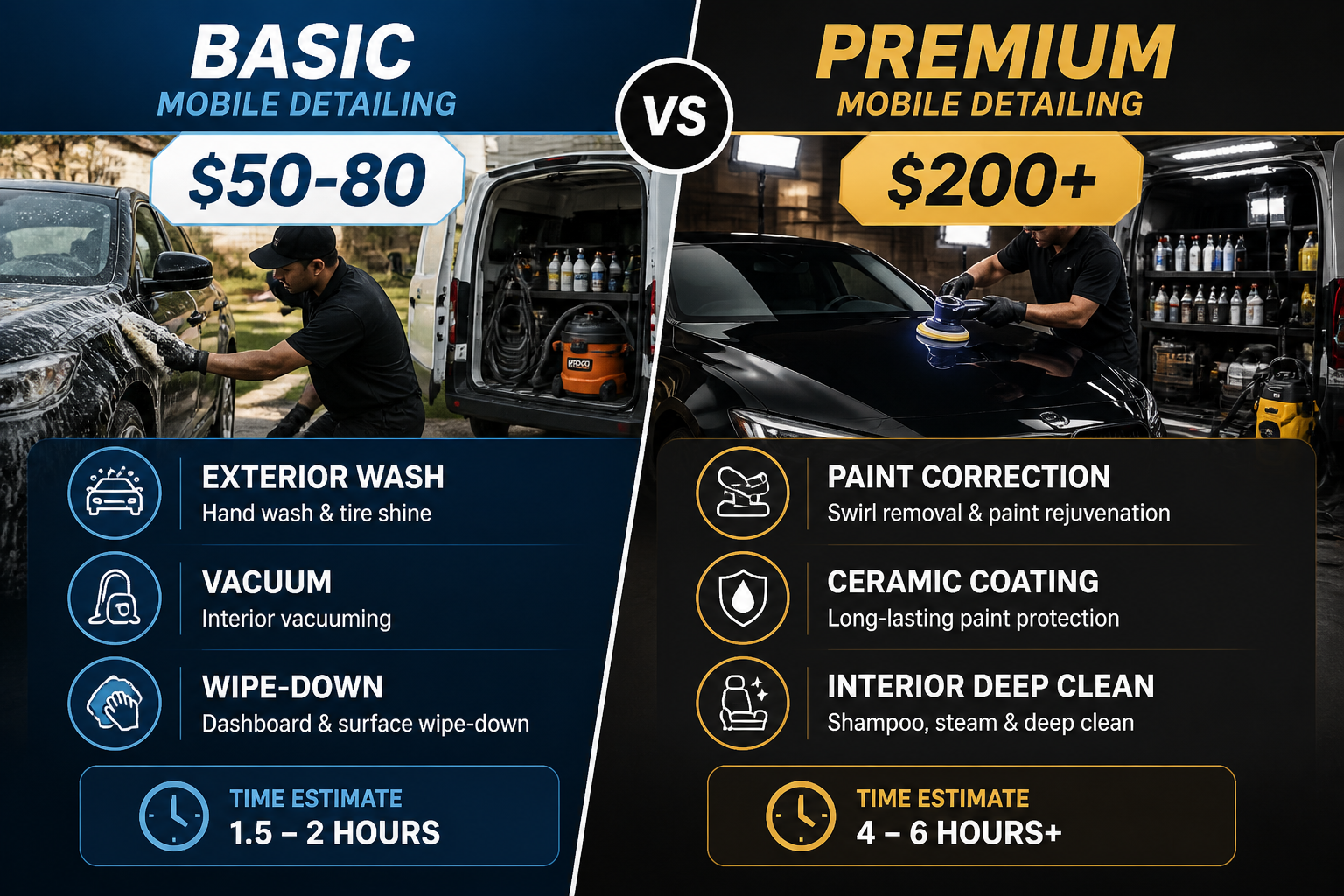
Pricing for basic mobile car detailing ranges from $50-120 based on vehicle size, with most operators charging $60-80 for standard sedans and $80-100 for larger vehicles. Your final price should cover all costs plus generate a healthy profit margin of 40-60%.
Standard pricing by vehicle type:
- Compact cars/Coupes: $50-70.
- Sedans/Mid-size: $70-90.
- SUVs/Crossovers: $90-110.
- Large trucks/Vans: $100-120.
Geographic pricing variations:
- Urban markets: 20-30% higher than rural areas.
- High-income neighborhoods: Premium pricing acceptable.
- Competitive markets: Price matching may be necessary.
- Seasonal demand: Winter pricing is often 10-15% lower.
Choose higher pricing if you offer superior service quality, have strong customer reviews, or operate in affluent areas. Price is lower when starting to build clientele, but avoid underpricing that makes profitability impossible.
What Costs Must You Factor Into Mobile Detailing Pricing?
Direct costs per job typically range from $15-25, including supplies, fuel, and proportional equipment costs. Understanding these expenses ensures your pricing covers all costs while generating sustainable profits for business growth.
Supply costs per basic detail:
- Car wash soap and chemicals: $3-5.
- Microfiber towels and cleaning cloths: $2-3.
- Interior cleaners and protectants: $3-5.
- Water (if using customer’s supply): $0-2.
- Total supply cost: $8-15 per job.
Operational expenses:
- Fuel and travel time: $5-10 per job.
- Equipment depreciation: $3-5 per job.
- Insurance and licensing: $2-3 per job.
- Total operational cost: $10-18 per job.
Labor considerations:
- Your hourly rate goal: $25-50/hour.
- Job completion time: 1.5-2.5 hours.
- Labor cost: $37.50-125 per job.
A common mistake is underestimating travel time between jobs, which can significantly impact daily profitability. Factor in 30-45 minutes of travel and setup time per appointment when calculating true hourly earnings.
How Do You Research Competitive Pricing in Your Market?
Market research for mobile detailing pricing involves analyzing 5-10 local competitors’ published rates, calling for quotes as a potential customer, and understanding your area’s economic demographics. This research should be completed before setting your initial pricing structure.
Research methods:
- Online competitor analysis: Check websites, Google listings, and social media for published pricing.
- Mystery shopping: Call competitors for quotes on identical services.
- Customer surveys: Ask existing customers what they previously paid elsewhere.
- Industry associations: Local detailing groups often share market rate information.
Key factors affecting local pricing:
- Average household income in the service area.
- Number of competing mobile detailers.
- Seasonal demand patterns.
- Commercial vs. residential customer mix.
Pricing positioning strategies:
- Premium positioning: 10-20% above market average (requires superior service).
- Competitive positioning: Within 5% of market average (most common).
- Value positioning: 10-15% below average (volume-focused strategy).
The edge case to consider: extremely competitive markets may require non-price differentiation (faster service, eco-friendly products, or specialized expertise) rather than competing solely on cost.
Should You Offer Package Deals or Individual Service Pricing?
Package pricing for mobile car detailing typically generates 15-25% higher revenue per customer compared to individual service pricing. Customers perceive greater value in bundled services, and packages simplify your pricing structure while encouraging upsells.
Effective package structures:
- Basic Package: Wash, vacuum, windows ($60-80).
- Standard Package: Basic + wax + tire shine ($85-110).
- Premium Package: Standard + interior protection + detail ($120-150).
Package pricing advantages:
- Simplifies customer decision-making.
- Increases average transaction value.
- Reduces price comparison shopping.
- Builds customer loyalty through perceived value.
Individual pricing benefits:
- Appeals to budget-conscious customers.
- Allows precise service customization.
- Easier to adjust for market changes.
- Transparent cost structure.
Choose package pricing if your target market values convenience and comprehensive service. Use individual pricing when serving price-sensitive customers or offering highly specialized services that don’t bundle well together.
How Often Should You Adjust Your Mobile Detailing Prices?
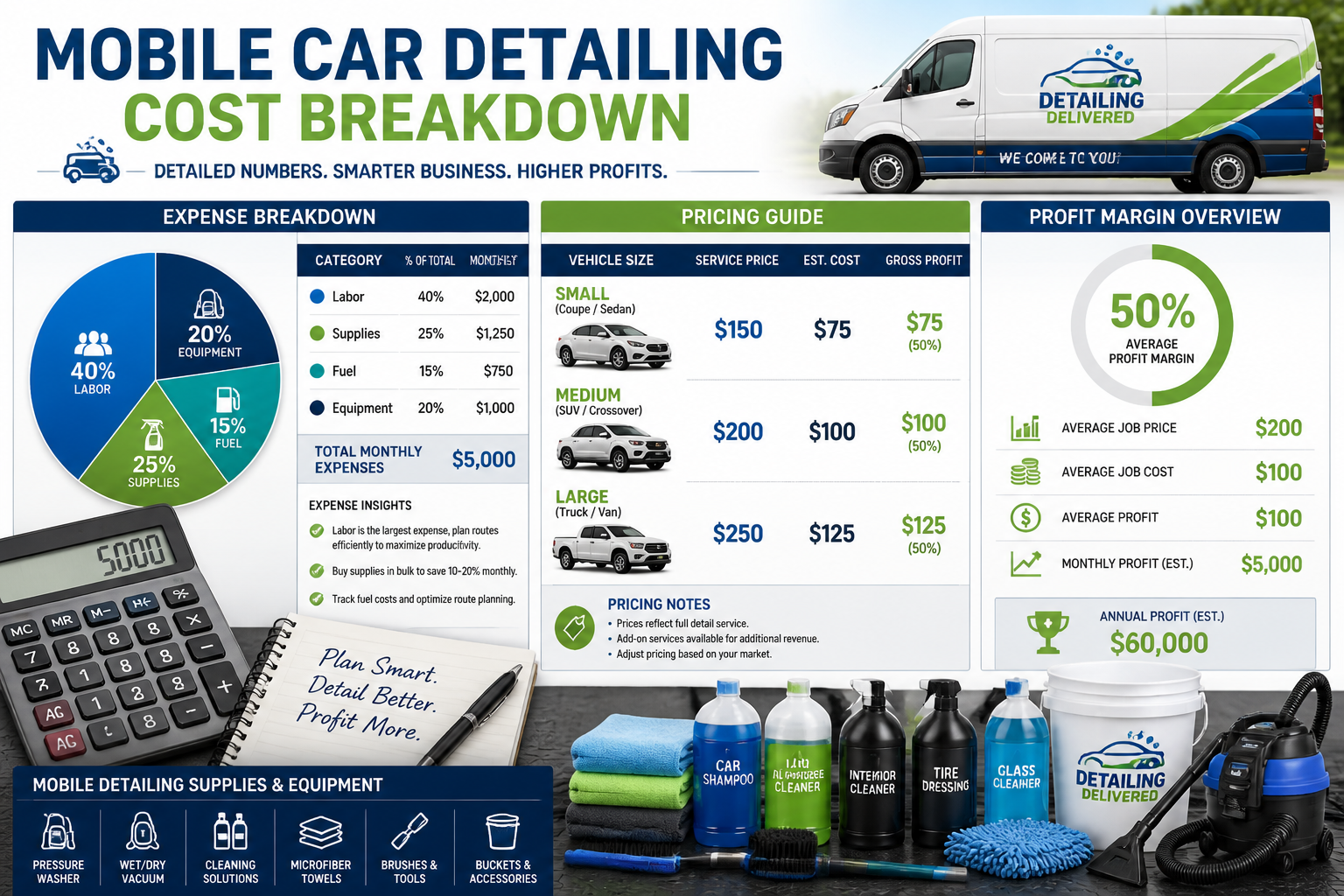
Mobile detailing prices should be reviewed quarterly and adjusted annually or when significant cost changes occur. Regular price evaluation ensures profitability while maintaining competitive positioning in your local market.
Timing for price adjustments:
- Annual increases: 3-5% to match inflation and cost increases.
- Seasonal adjustments: Higher summer rates, potential winter discounts.
- Cost-driven changes: When supply or fuel costs increase significantly.
- Market-driven changes: When competitor pricing shifts substantially.
Price increase implementation:
- Give existing customers a 30-day notice.
- Grandfather’s current pricing for loyal customers is temporary.
- Emphasize service improvements or added value.
- Test new pricing with new customers first.
Warning signs you need to raise prices:
- Profit margins below 40%.
- Booked solid with long waiting lists.
- Supply costs increased by more than 10%.
- Haven’t raised prices in over 18 months.
The common mistake is avoiding price increases due to fear of losing customers. Well-communicated, reasonable increases (5-10% annually) rarely result in significant customer loss, especially when service quality remains high.
Conclusion
Successfully pricing a basic mobile car detail requires balancing cost coverage, profit goals, and market competitiveness. Start with the $50-120 range based on vehicle size, ensure your pricing covers all direct costs plus generates 40-60% profit margins, and research local competitors to position appropriately.
FAQ
How much profit should I make on each mobile car detail?
Target a 40-60% profit margin after all direct costs. On a $75 basic detail, aim for $30-45 in profit after supplies, fuel, and labor costs.
What’s the minimum I should charge for mobile car detailing?
Never charge less than $50 for basic service, as this barely covers costs and travel time. Pricing below this level makes sustainable business operations nearly impossible.
How do I handle customers who say my prices are too high?
Explain your value proposition, show cost breakdowns if appropriate, and offer a basic package option. Don’t compete solely on price with low-quality operators.
Should I charge extra for travel outside my normal service area?
Yes, add $10-25 for locations more than 15 miles from your base, or include travel time in your hourly rate calculation.
How do luxury car owners affect pricing strategies?
Luxury vehicle owners often accept premium pricing (20-30% higher) but expect exceptional service quality and attention to detail.
What payment methods should I accept for mobile detailing?
Accept cash, credit cards, and mobile payments (Venmo, Cash App). Card processing fees (2.9%) should be factored into your pricing.
How do I price detailing for fleet or commercial accounts?
Offer 10-20% discounts for regular commercial accounts (5+ vehicles monthly) but ensure volume still maintains profitability.
Should I offer discounts for first-time customers?
A 10-15% new customer discount can attract business, but avoid deep discounting that devalues your service in customers’ minds.
How do weather conditions affect mobile detailing pricing?
Consider premium pricing (10-20% extra) for extreme weather conditions or offer rescheduling options during unsuitable weather.
What’s the best way to communicate price increases to existing customers?
Send personal notifications 30 days in advance, explain reasons (cost increases, service improvements), and thank them for their loyalty.